AFP for Marine Decks: What a Landmark 2025 Review Says About Its Promise and Its Limits
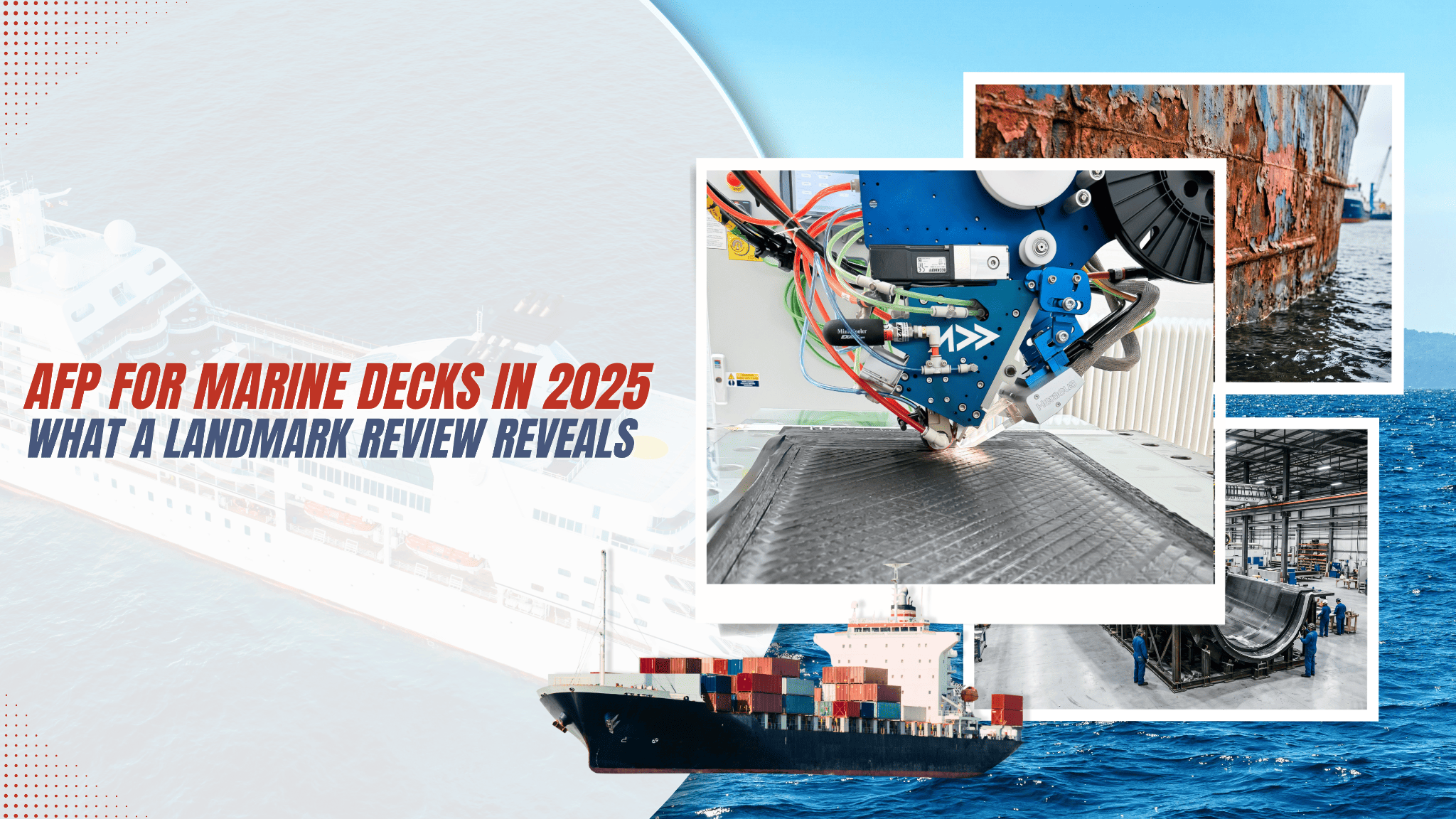
When a fiber placement process gets singled out by name in a broad, peer-reviewed survey of an entire industry, that is worth a pause. It happened in August 2025. A comprehensive open-access review in Polymers (MDPI), authored by Wijewickrama and colleagues, mapped the current state of fiber-reinforced composite (FRC) manufacturing for marine decks and underwater structures. Among the handful of processes it foregrounds, automated fiber placement (AFP) appears alongside vacuum-assisted resin transfer molding (VARTM) as one of the advanced techniques the authors associate with efficient production of high-performance marine components.
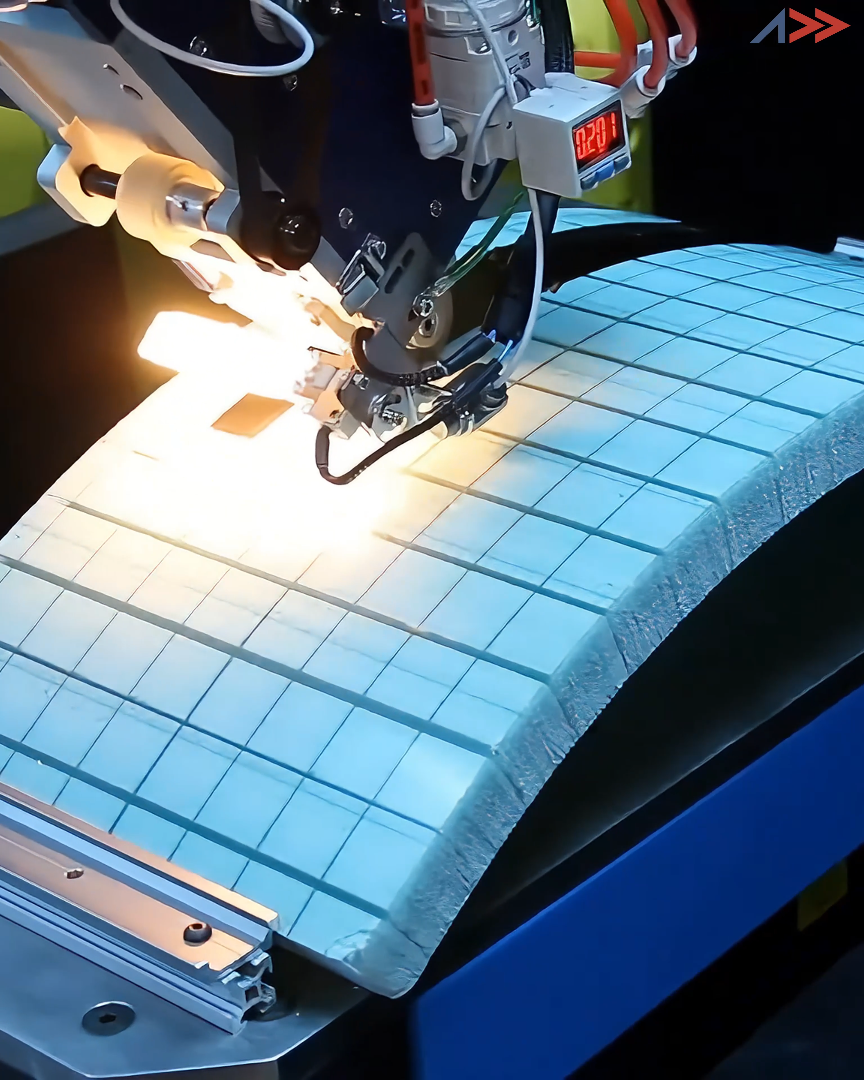
AFP-XS depositing prepreg tow on a curved composite mold tool — the process the 2025 Polymers review names as an advanced technique enabling high-performance marine composite production.
What makes the review useful rather than merely flattering is its candor. The paper does not present AFP as a finished solution for marine work. In the same breath that it credits AFP and VARTM with enabling efficient production, it flags where both still fall short for marine deployment: scalability and in-field repair. For anyone building a marine program around carbon fiber-reinforced polymer (CFRP), that pairing — a structural endorsement next to a clear-eyed list of gaps — is exactly the kind of signal worth reading closely.
This post walks through what the review actually says, visualizes the underlying numbers it reports, and then — clearly separated from the paper itself — offers our own perspective at Addcomposites on what those findings mean for AFP as a marine manufacturing route.
Why marine decks are a brutal test case
Before getting to manufacturing, the review establishes why marine structures are such a demanding environment for any material. According to the authors, marine decks sit at the intersection of several aggressive stressors at once: corrosion from salt water, the push and pull of waves and currents, fouling by marine life, and relentless load cycling. The paper notes that traditional metals such as steel and aluminum have long dominated here, but both carry well-known penalties in seawater — steel's susceptibility to electrochemical corrosion and the added dead weight it imposes, and aluminum's lower stiffness and vulnerability to galvanic attack.

Rust scaling and paint delamination on a working vessel hull — the seawater corrosion burden the 2025 Polymers review cites as the primary driver for transitioning marine structures to fiber-reinforced composites.
The case the authors build for FRCs rests on a few quantified advantages. The paper reports that swapping steel for composites in marine structures can cut structural weight by roughly 20–40%, with direct benefits for fuel efficiency and cargo capacity. It also cites CFRP tensile strengths exceeding 3,500 MPa, putting carbon composites in the same conversation as steel on strength while shedding the weight. Those two figures — the weight reduction band and the tensile threshold — frame the entire manufacturing discussion that follows.
It is also worth keeping the marine sector's scale in view. The review reproduces market data placing marine at about 12% of global FRP manufacturing by application — meaningful, but well behind automotive and construction. The data the paper presents looks like this:
FRP Market Share by Application (%)
Data as reported in the review (Figure 1)
Values represent share of total FRP demand across reported application segments.
The takeaway the authors draw from this landscape is that marine adoption is growing but still has room to run — and that the manufacturing route chosen is a large part of whether high-performance composites can capture more of that share.
The review is also frank about the failure modes that erode composites in service, and these are worth naming because they shape what a "good" manufacturing process has to deliver. According to the authors, the dominant seawater degradation pathways include matrix plasticization, hydrolysis of the polymer network, fiber–matrix debonding, and microcracking that opens new routes for water ingress. For carbon systems specifically, the paper highlights a less obvious risk: carbon fiber conducts electricity, so pairing CFRP with metal can set off galvanic corrosion, and that same conductivity also leaves the material more prone to lightning damage, which means extra shielding. Biofouling adds a separate, biological clock: the review describes fouling building in stages, with a thin conditioning layer settling almost immediately, a living film forming over the first week, and hard growth like barnacles taking hold within weeks. The reason all of this matters for manufacturing is straightforward — process quality (void content, fiber wet-out, consolidation) directly governs how quickly these mechanisms take hold.
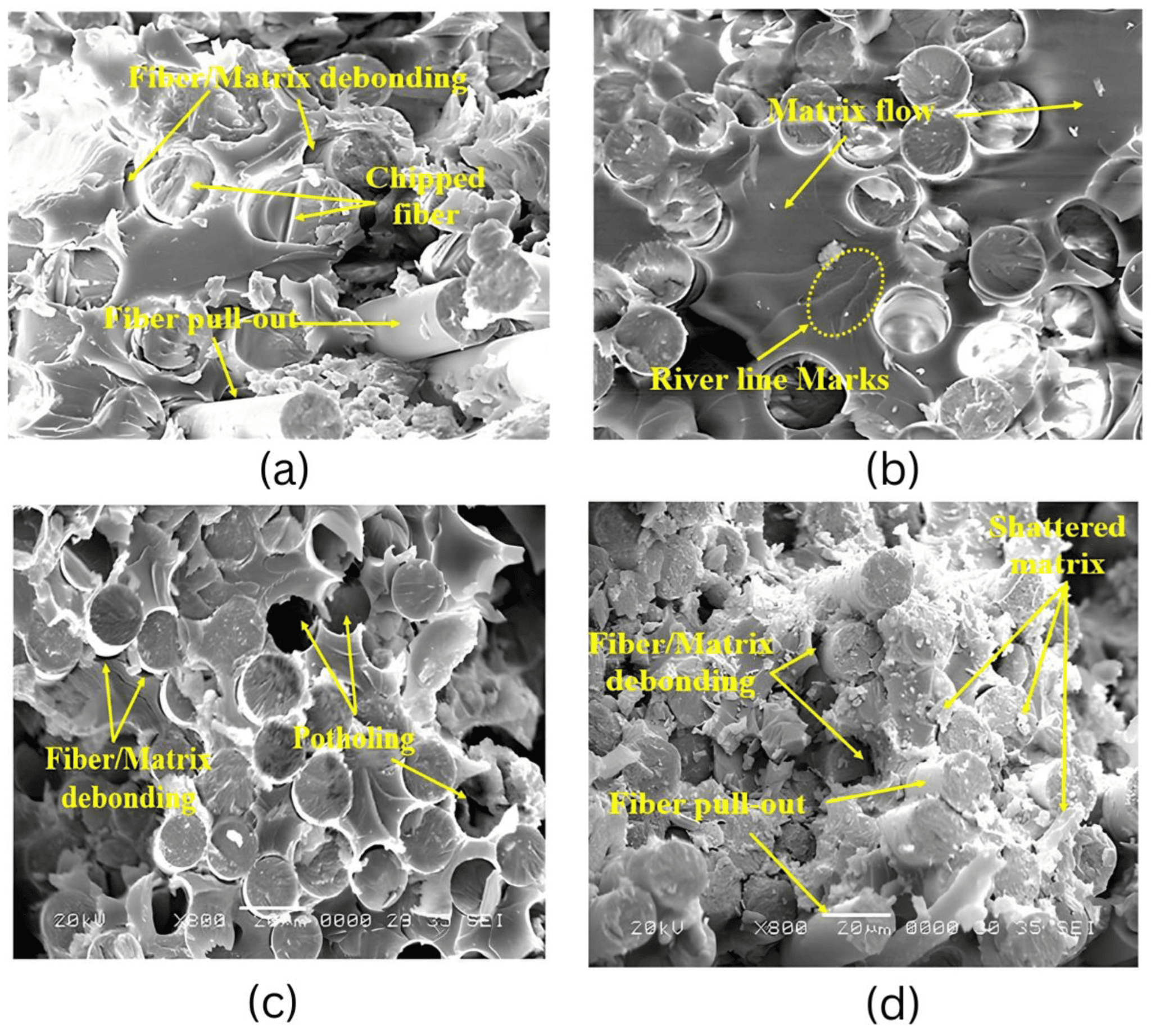
SEM fracture surfaces of E-glass/epoxy composite after 5 years (top row) and 11 years (bottom row) of seawater conditioning at 23 °C and 65 °C, showing fiber pull-out, fiber/matrix debonding, surface pitting, and progressive matrix fragmentation that intensifies with both temperature and immersion duration. Figure 5 from: Wijewickrama, L.; Jeewantha, J.; Perera, G.I.P.; Alajarmeh, O.; Epaarachchi, J. "Fiber-Reinforced Composites Used in the Manufacture of Marine Decks: A Review." Polymers 2025, 17, 2345. https://doi.org/10.3390/polym17172345 — © 2025 by the authors. Licensed under CC BY 4.0.
Where AFP sits in the manufacturing landscape
The review organizes marine composite manufacturing into a set of established and emerging processes: VARTM and RTM; AFP and automated tape laying (ATL); pultrusion and filament winding; and additive manufacturing (AM) as the newest entrant. Rather than ranking them on a single scale, the paper characterizes each by the component geometries and resin systems it suits best.
From the authors' descriptions, a rough positioning emerges. AFP is presented as a process that excels at placing slim prepreg tows precisely along curved and complex geometries, which in turn lets engineers dictate fiber direction and squeeze more structural efficiency out of each ply. For flatter, larger surfaces, ATL lays down wider tape and covers ground faster, at the cost of how tightly it can follow a contour. VARTM and RTM are cast as the workhorses for large structures such as hulls and decks, while filament winding handles hollow, pressure-resistant shapes like tanks and submersible hulls.
Here is that landscape mapped onto two axes the review's text implies — fiber-orientation control versus current marine scalability:
Manufacturing Process Positioning Matrix
Fiber-orientation control vs. marine scalability
This positioning is our interpretation of the qualitative descriptions in Section 2.4 of the review; the axes are editorial framing, not figures from the paper.
The review's own summary of manufacturing methods (its Table 8) reinforces a key point relevant to AFP: it is one of the few listed processes the authors flag as working with both resin families, thermoset and thermoplastic, the latter including high-end polymers like PEEK and PEKK once paired with the right heat source (the authors cite infrared and laser consolidation). The paper links that thermoplastic route to two payoffs marine teams value: parts that can be recycled, and faster cycle times.
The honest part: AFP's two named limitations
This is the section that gives the blog idea its spine. In the abstract, the authors credit both VARTM and AFP with making production efficient while cautioning that neither yet scales easily nor lends itself to repair once a structure is in service. The body text expands on the AFP side of that statement.
On adoption barriers, the authors report that AFP cuts scrap by roughly a third versus hand layup, but the machinery runs past a million US dollars and needs trained operators, a combination that keeps it out of reach for most smaller yards. They add that the process grew up around aerospace thermoset prepreg, so moving it to marine work takes adaptation rather than a straight lift.
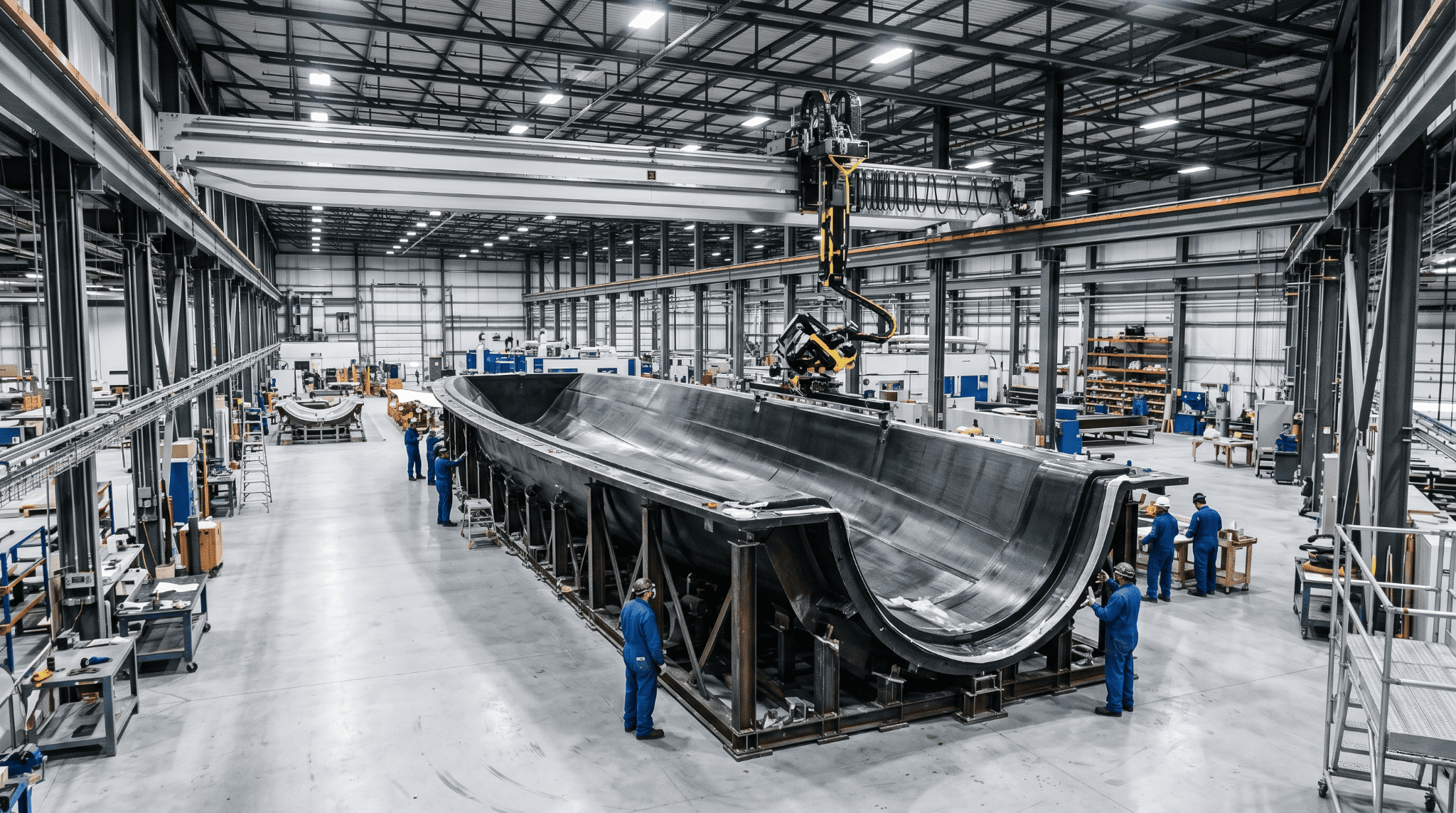
A large-format composite hull mold under a gantry-mounted AFP system — the kind of capital-intensive production environment the 2025 Polymers review identifies as a barrier to AFP adoption in smaller marine yards. AI-generated illustration.
On repair, the review draws a distinction between material systems rather than singling out AFP alone. The authors contrast the two matrix families: thermoset parts typically need heavy surface prep and a controlled cure to fix, which often means pulling the vessel into dry dock, while thermoplastic parts can instead be re-welded, though that calls for dedicated equipment. Either way, damp surfaces and cures that set unevenly make field repair harder.
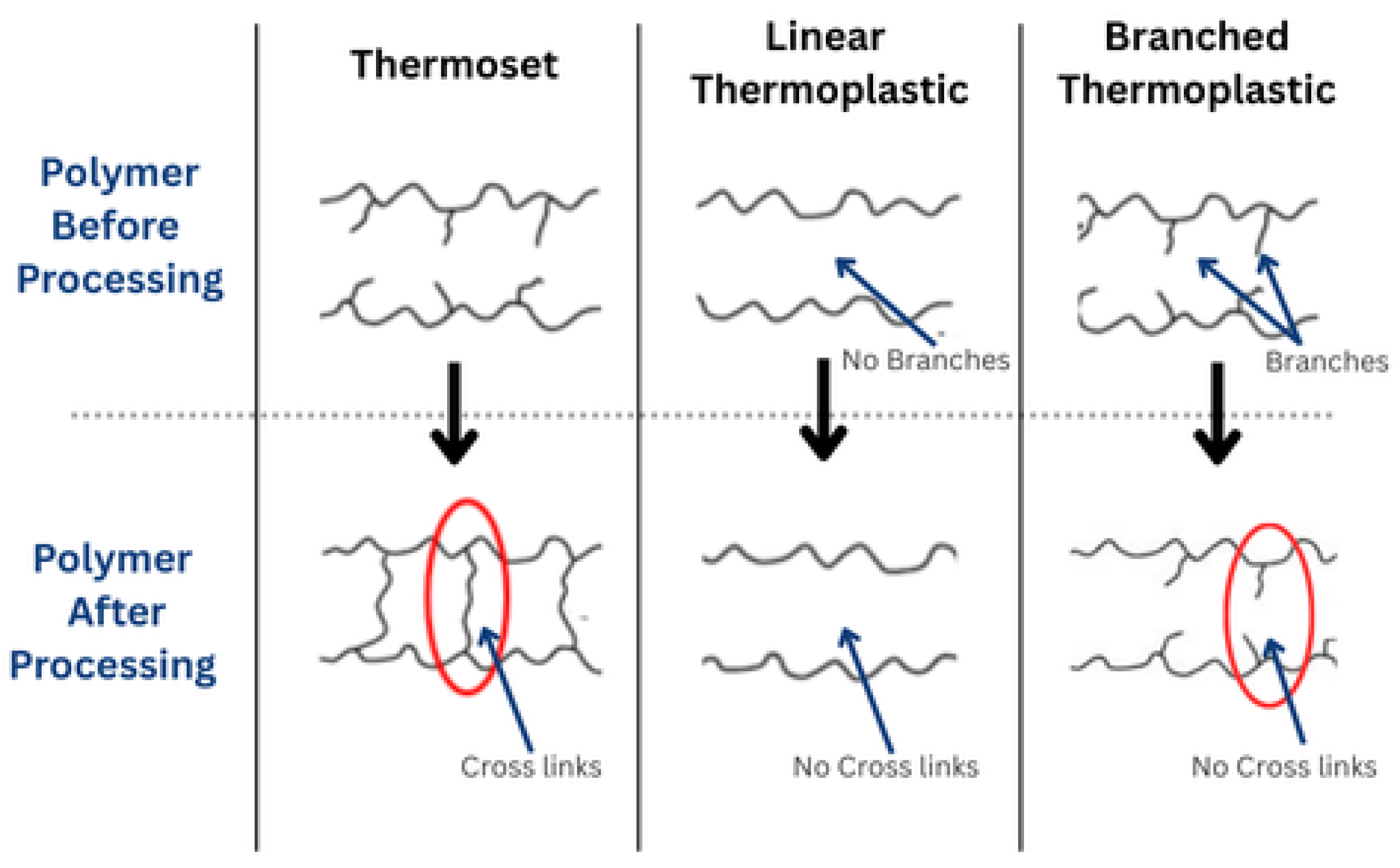
A molecular structure comparison showing thermosets (cross-linked, irreversible after processing) versus linear and branched thermoplastics (no cross-links, re-meltable) — the fundamental structural difference that governs why thermoplastic marine composites can be re-welded for field repair while thermoset parts cannot. Figure 3 from: Wijewickrama, L.; Jeewantha, J.; Perera, G.I.P.; Alajarmeh, O.; Epaarachchi, J. "Fiber-Reinforced Composites Used in the Manufacture of Marine Decks: A Review." Polymers 2025, 17, 2345. https://doi.org/10.3390/polym17172345 — © 2025 by the authors. Licensed under CC BY 4.0.
Put together, the review describes a recognizable gap between what AFP can build and how easily that build can be scaled and maintained in marine service:
AFP for Marine — as characterized in the review
The Performance-vs-Deployment Gap
Where AFP excels structurally, and where it still falls short for marine adoption
What AFP delivers
-
Controlled fiber orientation
-
Improved load-bearing efficiency
-
Thermoset + thermoplastic compatibility
-
CFRP weight savings~20–40% vs steel
What holds AFP back
-
1
ScalabilityLarge hull / deck structures
-
2
In-field repairIn-service damage, field cure / contamination
It is important to be precise about what the authors are and are not saying. The paper does not conclude that AFP is unsuitable for marine work. It identifies AFP as an enabling process for high-performance marine composites and then names the specific engineering problems — large-format scalability and a practical repair workflow — that stand between that capability and routine marine deployment.
Why the structural case still carries weight
The reason those limitations matter is that the underlying performance argument for CFRP, the material AFP places most precisely, is strong in the review's own data. Two themes stand out: weight and durability under seawater.
On weight, beyond the general 20–40% structural reduction figure, the paper reports more specific cases. It cites a 30–40% lighter hull when CFRP replaces steel in naval construction, and for submarine pressure hulls, CFRP coming in 20–30% lighter than a steel hull of equal capability without giving up strength.
On durability, the review compiles retention ranges that, while they vary with conditions, paint a consistent picture: carbon and high-performance thermoplastic systems hold their properties better than glass thermosets after prolonged seawater exposure. The approximate ranges the authors report include the following:
Approximate ranges reported across the review
Mechanical Property Retention After Seawater Exposure
Bars show retained performance relative to dry baseline (100%)
epoxy/carbon
70–90% tensile strength retained
(prolonged)
>90% tensile strength retained (prolonged)
~50–70% fatigue life retained (30–50% loss)
>80% fatigue life retained (<20% loss)
80–85% fatigue life retained
The review attributes the standout thermoplastic performance largely to PEEK's water-shedding chemistry and its stability when hot and wet. That detail connects directly back to the manufacturing discussion: because the authors list AFP as compatible with PEEK and PEKK, the process is positioned to build precisely the material systems that the durability data favors.
The paper also documents how hybrid fiber architectures can lift impact performance — relevant to naval and protective marine structures. The Izod impact data it presents (reproduced in the review from an earlier source) shows hybridization reshaping the ranking of single-fiber baselines:
Data as reported in the review — Figure 10
Izod Impact Strength by Layup (kJ/m²)
Higher values indicate greater impact energy absorption
Carbon alone by 73%
What this data underscores is that the value of a precise placement process is not only in laying a single high-performance fiber, but in controlling where different fibers go within a hybrid laminate — which is precisely the kind of tailored architecture AFP is built to produce.
A figure worth keeping from the paper
For readers who want the review's own framing of how all these pieces connect — constituents, processes, performance evaluation, and applications — the authors provide an overview flowchart early in the paper.
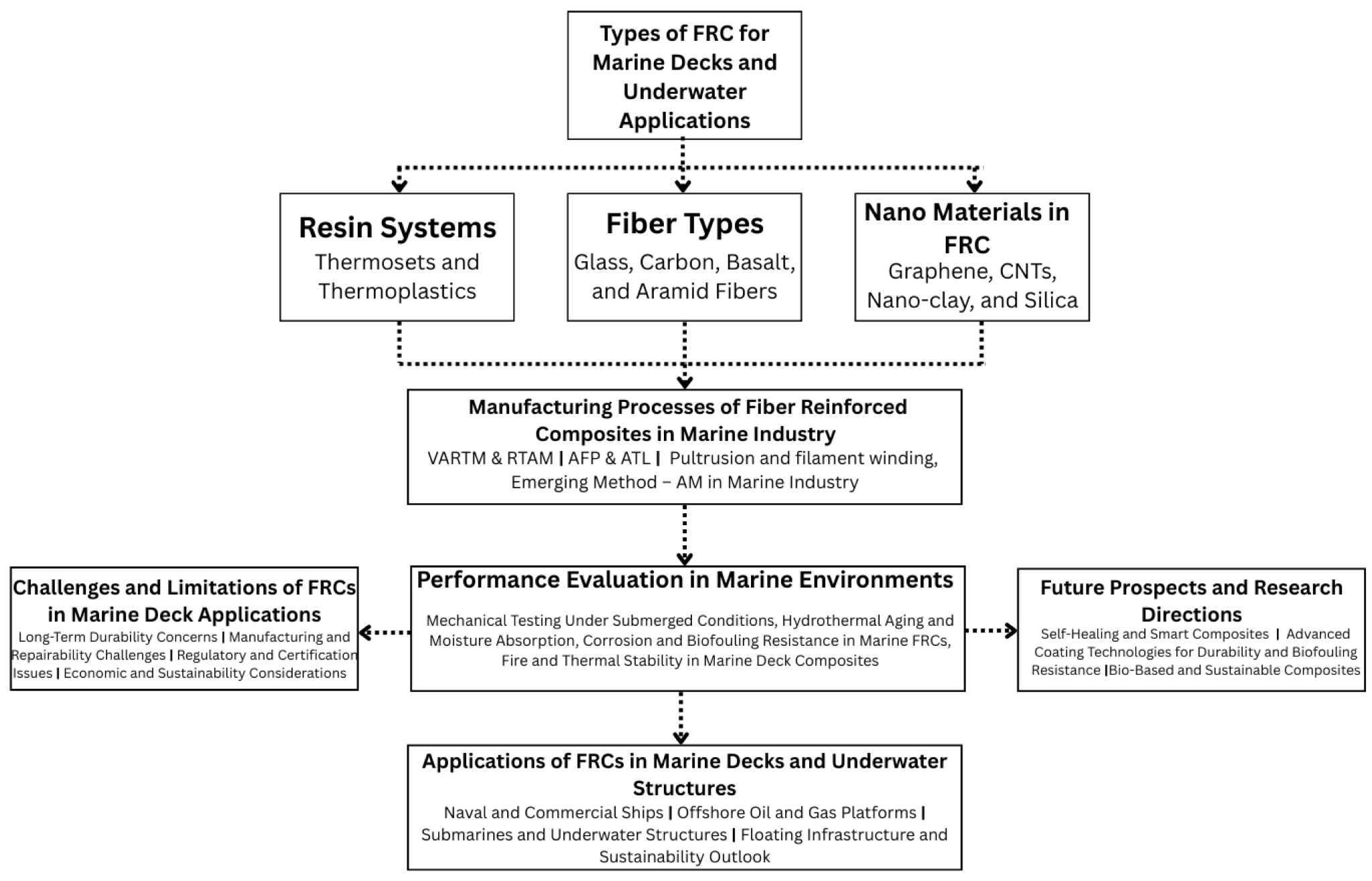
A review-level flowchart mapping the interconnections between FRC constituent materials (resin systems, fiber types, nanomaterials), manufacturing processes, performance evaluation in marine environments, application domains, and future research directions for marine and underwater structures. Figure 2 from: Wijewickrama, L.; Jeewantha, J.; Perera, G.I.P.; Alajarmeh, O.; Epaarachchi, J. "Fiber-Reinforced Composites Used in the Manufacture of Marine Decks: A Review." Polymers 2025, 17, 2345. https://doi.org/10.3390/polym17172345 — © 2025 by the authors. Licensed under CC BY 4.0.
The gap the review keeps returning to: certification
If scalability and repair are the manufacturing-side limitations, the review repeatedly circles a third, system-level constraint that sits on top of them: certification. The authors argue that existing test standards — they cite tensile, flexural, and fatigue protocols such as ASTM D3039, ASTM D7264, and ISO 13003 — give a starting point but were never built for the mixed, shifting loads of real marine service. They point out that sign-off can stretch to two years and run into six figures, and because each classification society can ask for its own test program, the burden multiplies for a builder juggling several material-and-process pairings.
The authors' proposed remedy is a three-step qualification ladder: standard bench tests to fix baseline properties; then an aging protocol that stacks salt, heat, and wave-type loading together rather than testing each in isolation; then validation on real structures using embedded monitoring (fiber Bragg gratings or carbon-nanotube sensors). That last step is notable because it points back at the materials themselves — the review elsewhere describes "smart" composites with embedded sensing as a route to predictive maintenance and early damage detection in submerged structures.
Proposed in the review
The Three-Step Qualification Ladder
Bench tests for baseline properties
Standard mechanical tests establishing the dry, undegraded property baseline for each material system.
Aging that stacks combined conditions
Salt + heat + wave-type loading applied simultaneously — not in isolation — to replicate true marine service environments.
On-structure check with embedded sensors
In-service monitoring using embedded FBG or carbon-nanotube sensors on actual structures, validating real-world performance.
Qualification confidence →
This thread matters to the AFP conversation because a scalable, repairable process is only half the adoption story; the other half is being able to prove long-term performance to a classification society. A process that can embed sensors and lay sensor-friendly architectures has an advantage in that proof.
Our perspective: reading the gaps as a roadmap
Everything above is the review's content. What follows is Addcomposites' own analysis, and it should be read as ours, not the authors'.
We see the review's two named limitations — scalability for large marine structures and in-field repair — less as a verdict against AFP and more as a specification for the work that turns AFP into a default marine process. The structural case the paper documents is not in dispute; the question is engineering and program execution.
On scalability, the relevant variable is not whether AFP can place fiber precisely — the review already credits it for that — but whether large-format layup can be made productive enough to compete with VARTM on hulls and decks. That is a tooling, deposition-rate, and cell-design problem. It is the kind of problem that gets solved by making AFP hardware accessible to more than a handful of aerospace primes, so that marine fabricators can develop their own large-panel processes rather than waiting for aerospace to hand them one. Our AFP-XS and AFP-X systems exist precisely to lower that barrier to entry, and the ADDX platform is aimed at the larger-envelope work where marine panels and inserts live.
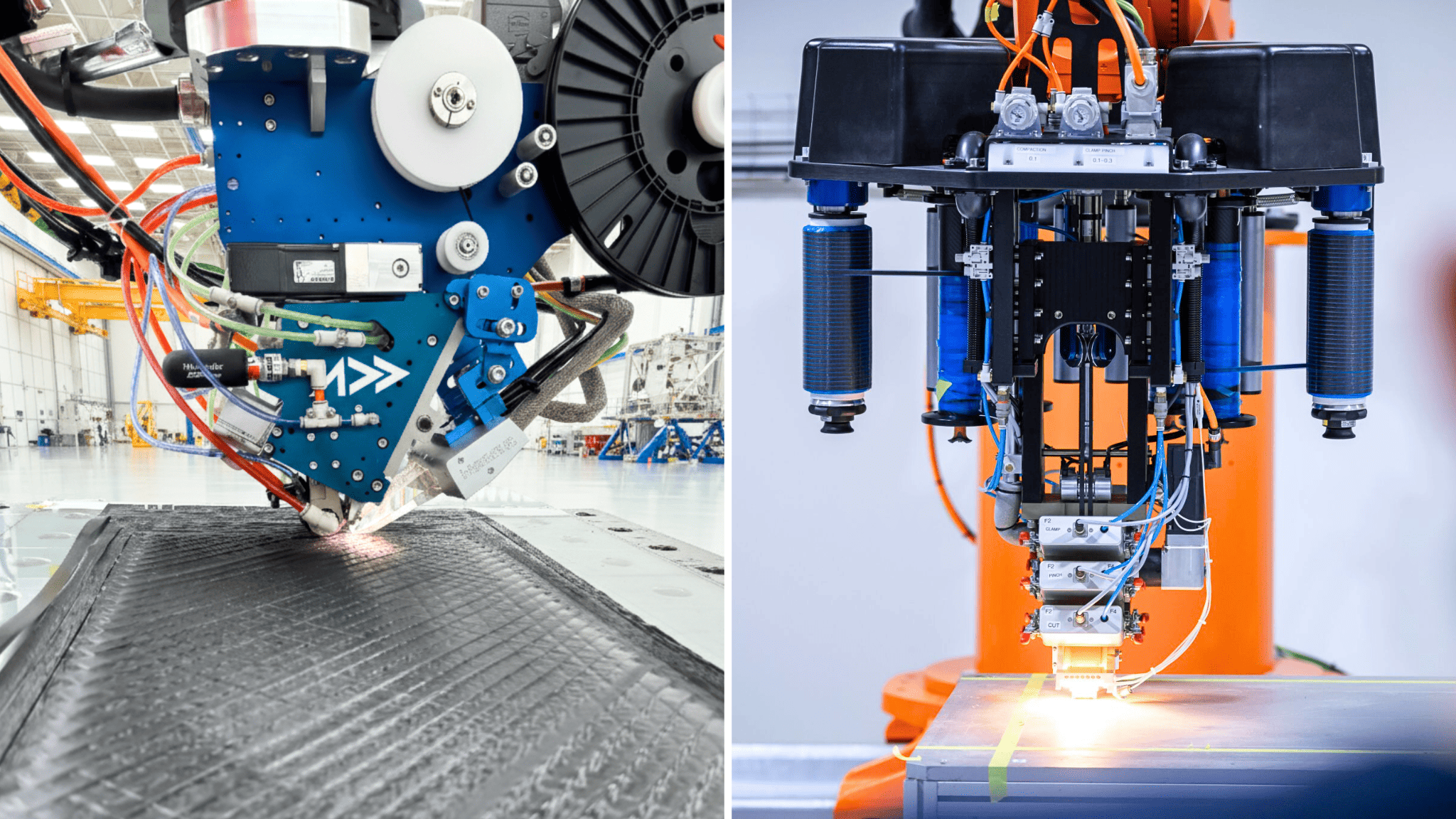
AFP-XS (left) and AFP-X (right) in active deposition on large-format composite panels — the two systems Addcomposites has built to lower the cost and complexity threshold the 2025 Polymers review identifies as the primary barrier to AFP adoption in marine manufacturing.
On repair, the review's distinction between thermoset and thermoplastic repair behavior is the most actionable detail for marine planners. If thermoplastic systems offer a more practical field-repair path, then the AFP-plus-thermoplastic route the paper describes is not just a durability play — it is also a maintainability play. We read that as an argument to invest in repeatable thermoplastic AFP workflows and the path planning to support them, which is the problem AddPath is built to address.

Generating AFP toolpaths in AddPath — the programming and simulation layer Addcomposites builds to make thermoplastic AFP workflows repeatable and maintainable in production.
To be explicit about the boundary: the authors of the review did not evaluate, endorse, or comment on Addcomposites, AFP-XS, AFP-X, ADDX, or AddPath. The connections drawn in this section are ours. The review's value to us is that it states the marine-AFP gaps clearly enough to aim at.
For marine program managers weighing manufacturing routes, the practical synthesis is this: the review hands you the performance argument for CFRP and the precise list of process gaps you need to close to deploy it at scale. Closing the scalability gap means large-format AFP capability you can actually operate; closing the repair gap means a thermoplastic-friendly workflow with a documented field path. Both are buildable today.

Read the Research
This post is a commentary on, and summary of, an independent peer-reviewed review. For the full study, including all data, figures, and citations, read the original open-access paper:
Wijewickrama, L.; Jeewantha, J.; Perera, G.I.P.; Alajarmeh, O.; Epaarachchi, J. Fiber-Reinforced Composites Used in the Manufacture of Marine Decks: A Review. Polymers 2025, 17, 2345. https://doi.org/10.3390/polym17172345
Published 29 August 2025 by MDPI. Open access under the Creative Commons Attribution (CC BY 4.0) license.
All quantitative figures, retention ranges, market shares, and process characterizations attributed to "the review," "the paper," or "the authors" in this post originate from the above study. Statements framed as "our perspective" or "Addcomposites' analysis" are editorial and are not drawn from, or endorsed by, the paper's authors.
Learn More
Get in touch to discuss your marine AFP application →
Contact Us for a ConsultationReferences
- Wijewickrama, L.; Jeewantha, J.; Perera, G.I.P.; Alajarmeh, O.; Epaarachchi, J. Fiber-Reinforced Composites Used in the Manufacture of Marine Decks: A Review. Polymers 2025, 17, 2345. https://doi.org/10.3390/polym17172345
- Addcomposites. AFP-XS Automated Fiber Placement System. https://www.addcomposites.com/afp-xs
This post was prepared by the Addcomposites team. Addcomposites develops the AFP-XS automated fiber placement platform. For questions about marine AFP process development, contact us at addcomposites.com.
