The Full Military Composites Landscape in 2026: Where CFRP Wins and Where It Is Still Challenged
A new open-access review gives defense manufacturers something they rarely get in one place: a side-by-side map of where composite materials are deployed across every major military domain, and an honest accounting of where carbon fiber actually earns its premium versus where it still loses ground to cheaper or tougher alternatives.
Published in January 2026 in Advances in Materials Science and Engineering (Wiley) and authored by Mikru Birhan, Besufekad Negash, Temesgen Batu, and Yobel Abunu of the Ethiopian Defence University, the review draws on 201 peer-reviewed studies published between 2000 and 2024. It compares mechanical, ballistic, thermal, and stealth-related behaviour for the main fiber systems, and it does so domain by domain: aircraft, unmanned air systems, naval vessels, ground vehicles, missiles, and personal protective equipment.
The reason this matters for anyone building composite structures is simple. Each military domain has a different first-order requirement. Aircraft want stiffness per kilogram. Submarines want acoustic quiet and corrosion immunity. Armor wants multihit ballistic resistance. A helmet wants the lowest possible mass on a soldier's neck. Carbon fiber reinforced polymer (CFRP) does not win all of those contests, and the review is refreshingly direct about the ones it does not. Below we walk through the landscape as the paper presents it, then add our own read on what it means for automated manufacturing.

Twelve images illustrating composite material applications across defense and industrial domains: a ballistic helmet and composite vehicle body (personal protection and land systems), a stealth combat aircraft and commercial airliner (aerospace), a naval aircraft carrier (naval), a desert military vehicle, space station, rocket launch, dome structure, and industrial storage tank. AI-generated illustration recreated from Figure 1 in: Mikru Birhan, Besufekad Negash, Temesgen Batu, and Yobel Abunu. "Integrating Composite Materials Throughout the Military Sector: A Review." Advances in Materials Science and Engineering 2026, Vol. 2026, Article ID 9931653, p. 2. https://doi.org/10.1155/amse/9931653 — © 2026 by the authors. Licensed under CC BY 4.0 (https://creativecommons.org/licenses/by/4.0/).
A note on sourcing throughout this article: statements introduced with "the paper," "the review," or "the authors" describe findings from Birhan and colleagues. Sections marked "Our perspective" or "Addcomposites' view" are our own commentary and are not endorsed by the authors.
The baseline: who buys composites, and what each fiber brings
Before splitting by domain, it helps to see the demand picture. The review reproduces a market breakdown in which aerospace and defense dominate composite consumption by a wide margin, with every other end market trailing far behind.
Advanced Composites · Market Intelligence
Composite Material Market by End Sector
Share of global composite material consumption by application sector
Figure 6 from: Mikru Birhan, Besufekad Negash, Temesgen Batu, Yobel Abunu. "Integrating Composite Materials Throughout the Military Sector: A Review." Advances in Materials Science and Engineering 2026, Vol. 2026, Article ID 9931653, p. 6. https://doi.org/10.1155/amse/9931653 — © 2026 by the authors. Licensed under CC BY 4.0 (https://creativecommons.org/licenses/by/4.0/). Data redrawn as an ASCII bar chart from the original pie chart.
The second piece of baseline data is a property comparison across the five fiber systems the review treats as the workhorses of defense. We have redrawn its tensile-strength ranges as a span chart, because the overlap between materials is the whole story: there is no single "strongest" fiber, only a trade space.
Advanced Composites · Mechanical Properties
Tensile Strength Range by Composite Type
Comparative ranges in MPa — hover each bar for details · redrawn from Table 1
Table 1 from: Mikru Birhan, Besufekad Negash, Temesgen Batu, Yobel Abunu. "Integrating Composite Materials Throughout the Military Sector: A Review." Advances in Materials Science and Engineering 2026, Vol. 2026, Article ID 9931653, p. 6. https://doi.org/10.1155/amse/9931653 — © 2026 by the authors. Licensed under CC BY 4.0 (https://creativecommons.org/licenses/by/4.0/). Numeric ranges redrawn as an ASCII span chart from the original table.
The paper pairs each material with a typical military role: CFRP for aircraft fuselages and UAVs, GFRP for naval structures and shelters, aramid (Kevlar) for helmets and body armor, boron epoxy for missile skins and armor, and Kevlar-alumina for ballistic plates. Our perspective: what the chart makes visible is that CFRP combines the highest stiffness band with the lowest density. That pairing is exactly what wins in weight-driven applications, and it is also why CFRP carries a cost penalty the other fibers do not.
Aerospace and UAVs: a clear CFRP win, with a stealth asterisk
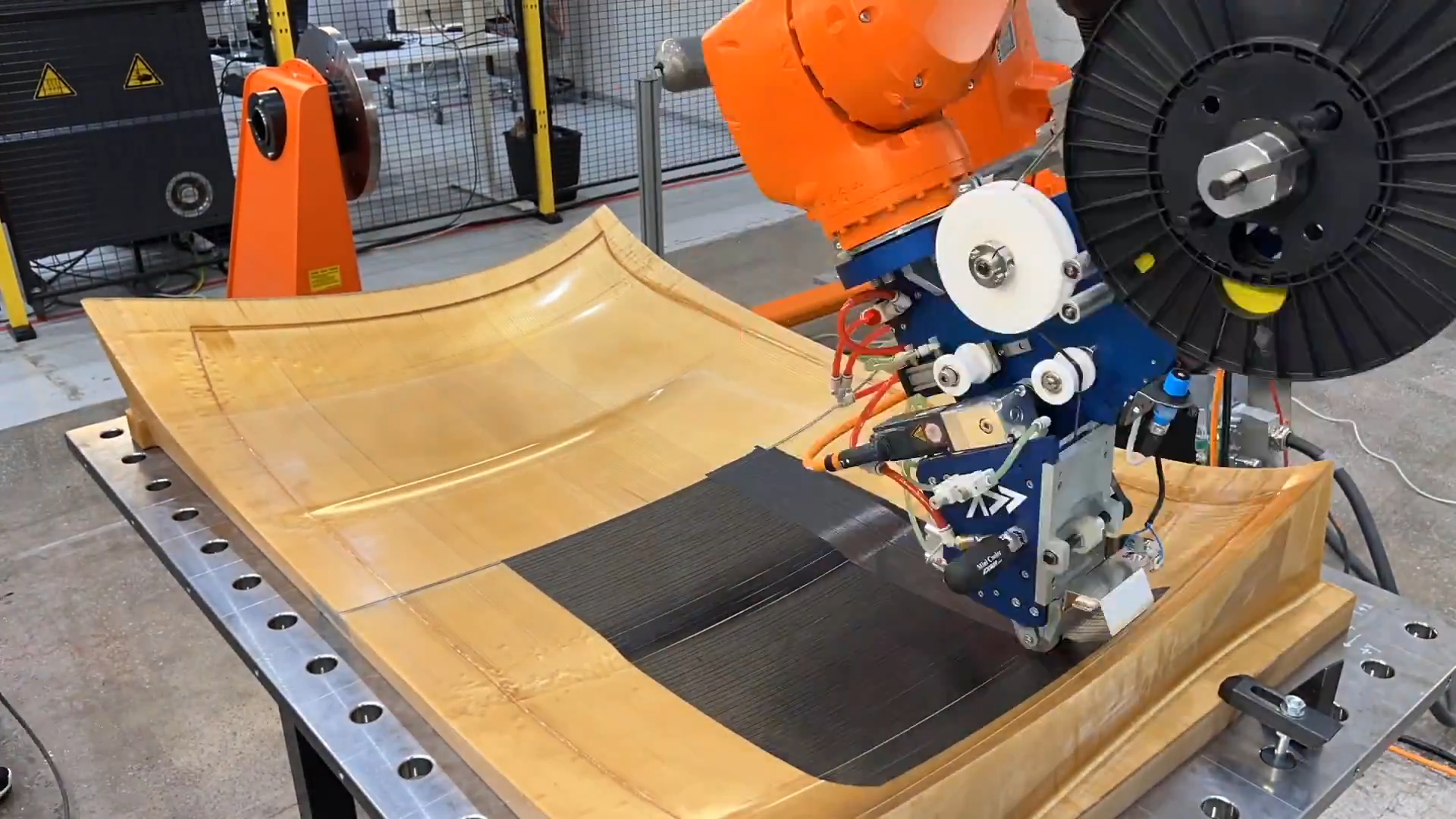
The AFP-XS automated fiber placement head deposits carbon fiber tow lanes across a contoured composite panel, illustrating the precision layup process behind structural components in modern military and aerospace platforms.
In aircraft, the review treats the case as effectively settled. It notes that modern airframes such as the Boeing 787 and the Airbus A350 XWB are built from more than half composite material by structural content, replacing aluminum alloys in primary structure. The authors attribute the shift to the strength-to-weight advantage, which converts into fuel savings, range, payload, and lower lifecycle maintenance because composites resist corrosion and fatigue better than the metals they displace.
For unmanned air systems, the paper frames composites as central to the category's recent growth. Lighter airframes buy endurance and payload, and the design freedom of laminates opens up shapes like blended wing bodies that cut drag.
On the trade-offs, the review is even-handed, and cost turns out to be the dividing line. Glass fiber is the budget choice. Aramid sits in the middle, soaking up impact well even though it goes soft in compression. Carbon fiber sits at the top, unmatched on stiffness per kilogram but also the most expensive and the likeliest to crack apart under a hard strike.
This is where the stealth question gets interesting. The review lists low radar cross-section as a CFRP benefit and flags GFRP as less effective for stealth (Table 2), and in its UAV discussion it describes glass-fiber systems as less suitable for stealth because of higher radar signatures.
Addcomposites' view (editorial, not from the paper)
The radar picture deserves a caveat the review compresses. Bare carbon fiber is electrically conductive, which on its own makes an untreated CFRP skin a strong radar reflector rather than an absorber. Stealth performance in practice comes from radar-absorbing structures, lossy coatings, and geometry, not from the structural fiber alone. The broader materials literature through 2025 treats carbon-based fillers as building blocks for radar-absorbing materials precisely because their conductivity can be tuned. So "CFRP equals stealth" is a useful shorthand only when the layup is engineered for it. For a UAV program, that engineering—embedding absorber plies or controlling surface conductivity through the layup—is a manufacturing problem as much as a material one.
Aerospace & UAV · Material Selection
Aerospace / UAV Trade Space
Performance rating across five key attributes — hover any cell for context
per mass
tolerance
strength
suitability
cost
Naval: corrosion and quiet win, fatigue is the open question
At sea, the review's verdict flips from "settled" to "contested." Composites earn their place in hulls and superstructures through corrosion immunity and weight reduction, which lower lifecycle cost and lift speed and payload. In submarines and underwater vehicles, the authors emphasize acoustic stealth: composites damp sound, which reduces the noise signature and helps a vessel run undetected. Glass fiber also shows up in mine countermeasure vessels for its low magnetic signature.

HMS Bangor (M109), a Sandown-class minehunter with a glass-reinforced plastic hull designed for minimal magnetic signature, underway in the Arabian Sea, February 2017. Photo: US Navy (180207-N-TB177-0117). Public domain.
The limitation the paper keeps returning to is fatigue. According to the authors, carbon-fiber and sandwich builds shed both weight and noise, yet their fatigue endurance falls off once a hull is pressure-cycled at depth again and again. Glass-reinforced layups are cheaper but take on water over the years, and the paper points to mixed carbon-and-glass construction as the more balanced route.
The authors are candid that nobody has fully mapped how these hulls hold up under years of repeated deep-pressure loading, and that fixing a composite hull at sea is hard enough that designers often leave metal sections in place to keep repairs quick.
Our perspective
The naval challenge is less about the fiber and more about confidence. A submarine pressure hull is a fatigue-and-inspection problem, and the data gap the paper identifies is what keeps composites in a supporting rather than primary structural role for many programs. That gap closes with better process consistency and embedded monitoring, both of which point back to how the part is made.
Land systems: ballistic protection that still trades against multihit and cost
Ground vehicle armor is the domain where the paper is most detailed and most cautious. It describes modern protection as hybrid and layered, typically a ceramic strike face over a composite or metal backing, with a thin polymer skin shielding the ceramic tiles and a rubber interlayer that helps the panel survive a second and third hit.
Ceramic-and-aramid laminates trim mass without giving up much protection against mid-caliber rounds, while boron systems are extremely hard and shrug off repeat strikes, at a price few programs want to pay.
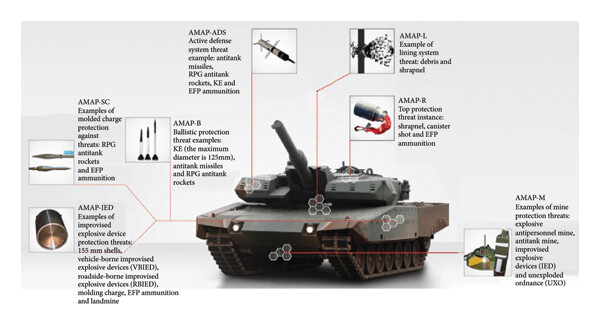
A labeled diagram of a modern main battle tank showing seven composite armor protection zones — ballistic, shaped charge, IED, mine, top-attack, interior lining, and active defense — each annotated with the threat types it defeats. Figure 7 from: Mikru Birhan, Besufekad Negash, Temesgen Batu, and Yobel Abunu. "Integrating Composite Materials Throughout the Military Sector: A Review." Advances in Materials Science and Engineering 2026, Vol. 2026, Article ID 9931653, p. 10. https://doi.org/10.1155/amse/9931653 — © 2026 by the authors. Licensed under CC BY 4.0 (https://creativecommons.org/licenses/by/4.0/).
The honest limitations: the review reports that ceramic-faced laminates do not take repeat hits as well as metal armor does, that boron systems are costly and hard to source, and that glass-reinforced layups, being the cheap option, tend to land in backup layers rather than the primary stop. The authors flag optimized hybrid stacks and scalable production as the research paths that would widen battlefield use.
They also raise a security angle that is easy to miss: as composite production gets more computerized, the process line itself becomes a target, and a sabotage study they cite showed that quietly tampering with ply angles can rob a part of strength or cut short how long it survives fatigue loading.
Addcomposites' view
The multihit-versus-weight tension is fundamentally a layup-architecture problem. Getting the ply sequence, local reinforcement, and consolidation right across a complex armor geometry is exactly the kind of repeatable, auditable process that hand layup struggles to guarantee, and the ply-orientation sabotage finding is a reminder that process traceability is now part of the threat model.
Personal protection: the cleanest weight win, undone by the environment
For helmets and body armor, the review presents the strongest weight argument of any domain. It reports that Kevlar-epoxy protective composites cut mass by close to 40% versus steel while improving ballistic impact resistance. The helmet section traces a long arc of materials substitution, which we have redrawn from the paper's timeline figure.
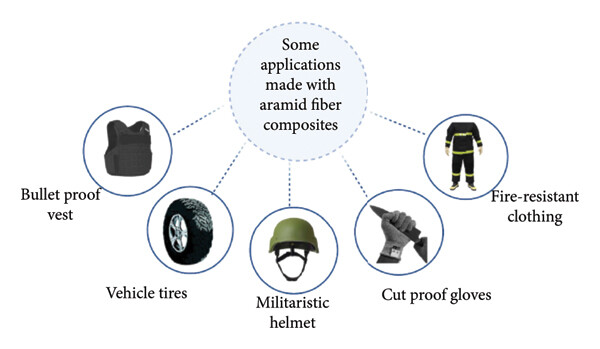
Five applications of aramid fiber composites in personal protective equipment: bulletproof vest, vehicle tires, military helmet, cut-proof gloves, and fire-resistant clothing. Figure 5(a) from: Mikru Birhan, Besufekad Negash, Temesgen Batu, and Yobel Abunu. "Integrating Composite Materials Throughout the Military Sector: A Review." Advances in Materials Science and Engineering 2026, Vol. 2026, Article ID 9931653, p. 6. https://doi.org/10.1155/amse/9931653 — © 2026 by the authors. Licensed under CC BY 4.0 (https://creativecommons.org/licenses/by/4.0/).
Defense & Protection · Technology History
Ballistic Helmet Evolution
From steel pot to next-generation hybrid composite systems · redrawn from Figure 5b
Steel shell, leather liner
Steel Pot
steel shell
Kevlar KM2, PASGT shape
composite shell
Improved Kevlar layup, lighter
Combat Helmet
High-cut, NVG-mount compatible
rail system
UHMWPE + aramid hybrid layup
Combat Helmet
Mandible + visor integration
protection system
Hybrid, electronics integration
integrated
Figure 5(b) from: Mikru Birhan, Besufekad Negash, Temesgen Batu, Yobel Abunu. "Integrating Composite Materials Throughout the Military Sector: A Review." Advances in Materials Science and Engineering 2026, Vol. 2026, Article ID 9931653, p. 6. https://doi.org/10.1155/amse/9931653 — © 2026 by the authors. Licensed under CC BY 4.0 (https://creativecommons.org/licenses/by/4.0/). Timeline redrawn as ASCII from the original figure.
The limitations the paper lists are environmental rather than ballistic. It notes that aramid sheds strength after repeated laundering and weakens under sunlight and damp, while polyethylene grades like Dyneema are superb energy absorbers that soften at relatively low temperatures. Stacking aramid, polyethylene, and ceramic plies together buys back multi-strike performance, but every added layer pushes up the build cost and makes the part fussier to manufacture. The authors see the next step as hybrids that stay light while tolerating heat and repairing themselves.
The thread running through every domain: how the part gets made
Our perspective: read the four domains together and a pattern jumps out, at least to us. Almost every entry in the review's "limitations" columns is, underneath, a question of whether the part was built consistently rather than a hard ceiling of the material itself. Delamination risk, fatigue scatter under cyclic loading, multi-strike reliability, stealth layups that need absorber plies in exactly the right place: all of them turn on how precisely and how repeatably the fibers get placed and consolidated.

The AFP-XS automated fiber placement system winding carbon fiber tow in a precision cross-hatch pattern on a cylindrical composite mandrel, demonstrating the repeatable automated layup process the review identifies as central to next-generation defense composite manufacturing.
The review's future-prospects section makes the same point. Among the manufacturing advances it singles out for defense composites, it calls out automated fiber placement (AFP) and automated tape laying (ATL) by name, crediting them with laying material down the same way every time, which takes the operator's hand, and the operator's mistakes, out of the loop. The paper traces both techniques from their aerospace origins outward into naval, ground-vehicle, and protective-equipment programs, and ties them to AI-driven defect detection, digital twins, and embedded-sensor "smart" fabrication.
Defense Manufacturing · Section 7.2.1
The Next-Generation Defense Composite Stack
Five manufacturing advances enabling next-gen defense composites · hover each branch for detail
Composite
Manufacturing
Diagram synthesized by Addcomposites from the manufacturing techniques discussed in Section 7.2.1 of Birhan et al., "Integrating Composite Materials Throughout the Military Sector: A Review," Advances in Materials Science and Engineering 2026, Article ID 9931653. https://doi.org/10.1155/amse/9931653. The grouping and layout are our editorial interpretation, not a figure from the paper.
This aligns with where the wider industry is heading. Independent 2025 market analyses put aerospace and defense as the dominant AFP end-segment, with one report estimating that a large majority of modern military aircraft already integrate AFP-produced components and citing roughly 20% material-waste reduction versus manual methods. The direction the review describes is not speculative; it is the current procurement reality.
Where this leaves automated-manufacturing programs
Here is our synthesis of the review's domain-by-domain verdict, built from its Table 2 and Table 3 summaries. The status column is our editorial reading, not a label the authors assign.
Advanced Composites · Domain Assessment
CFRP Status by Domain
Addcomposites synthesis of the review — verdict, rationale, and open challenge per application domain
Addcomposites' view. The strategic takeaway for anyone pitching CFRP capability to a defense program office is that the value proposition has to be told domain by domain, because the review shows it genuinely differs by domain.

AddPath generating automated fiber placement toolpaths for a composite laminate, with the AFP robot arm simulation active in the 3D viewport.
Where CFRP wins outright, in military aircraft, UAV airframes, and weight-critical missile components, the conversation is not about whether to use carbon fiber. It is about whether the manufacturing route can justify the material premium with structural efficiency, repeatability, and traceability. That is the case for accessible AFP.
The AFP-XS platform was built to bring automated fiber placement within reach of programs that previously could only afford hand layup, and AddPath handles the path planning and simulation that turn a complex defense geometry into a repeatable, inspectable process. Those are the problems the review keeps flagging; our argument, not the authors', is that process repeatability is the lever that addresses them.
Where CFRP is contested, in naval hulls and ground armor, the review effectively hands manufacturers a research agenda: hybrid carbon-glass architectures, better fatigue characterization under cyclic loading, optimized multihit layups, and scalable production. Every one of those is a fiber-placement problem before it is anything else. A hybrid layup is only as good as the precision with which the two fiber systems are interleaved. A multihit armor panel lives or dies on local reinforcement placed exactly where the threat model says it should be. These are the next-generation programs where automated placement is not a cost-down play but the enabling technology.
Our closing read. The most useful thing about this review is that it refuses to oversell. It treats composites as a set of trade-offs to be managed, not a miracle, and it locates most of the unsolved problems at the manufacturing layer. For an industry whose entire premise is making automated fiber placement accessible, that is the most encouraging conclusion possible: the materials are proven, and the remaining work is precisely the work that better process control exists to do.
Learn More
Get in touch to discuss your defense composite AFP application →
Contact Us for a ConsultationRead the Research
- Mikru Birhan, Besufekad Negash, Temesgen Batu, and Yobel Abunu. "Integrating Composite Materials Throughout the Military Sector: A Review." Advances in Materials Science and Engineering, 2026, Vol. 2026, Article ID 9931653, 27 pages. https://doi.org/10.1155/amse/9931653 Published by John Wiley & Sons Ltd. Open access under the Creative Commons Attribution (CC BY) License (https://creativecommons.org/licenses/by/4.0/), which permits use, distribution, and reproduction in any medium, provided the original work is properly cited.
Supplementary context on AFP market position and carbon-based radar-absorbing materials is drawn from independent 2025 industry and materials-science sources and is the responsibility of Addcomposites, not the review's authors.
