The Future Is Automated: Live Manufacturing Demos & Automation Innovations at JEC 2026
Executive Summary
JEC World 2026 has expanded its Live Demo Area more than any previous edition, with an unprecedented concentration of live manufacturing demonstrations spanning in-mold thermoplastic fusion, large-scale additive manufacturing, and robotic composite production. This expansion is no coincidence — it reflects an industry at an inflection point where automation is no longer optional. Labor shortages, quality consistency requirements, and cost pressures are converging to make automated composite manufacturing not just appealing but necessary.
This article previews every confirmed live demonstration at JEC 2026 and situates them within the broader automation mega-trend, connecting the show floor to the innovation award winner (SAUBER4.0) and the long-term democratization of AFP and filament winding technology that companies like Addcomposites are driving.
Why Live Demos Matter
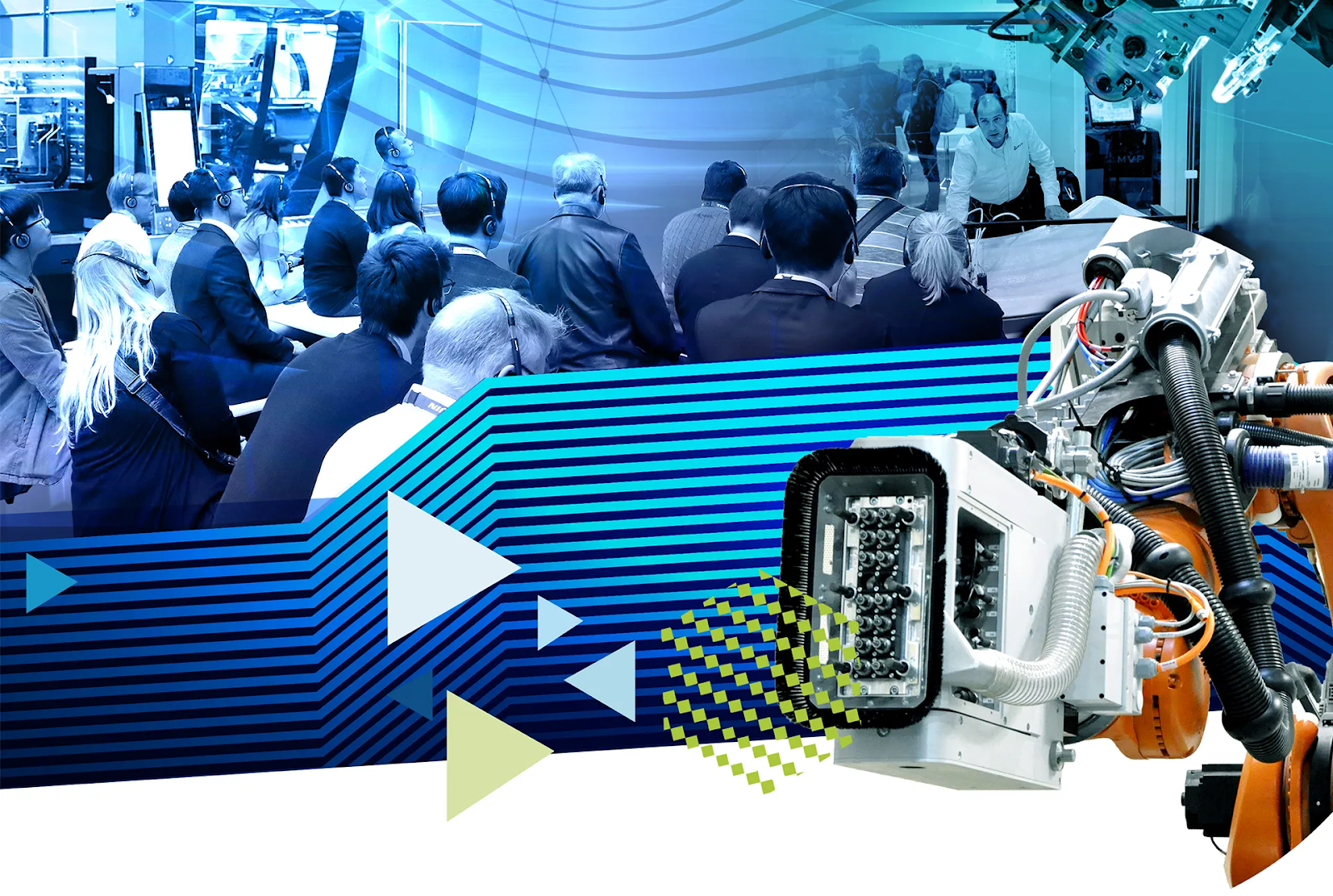
There is a particular electricity that runs through a manufacturing hall when machines are actually running. Datasheets can promise deposition rates and surface finish specifications, but watching a gantry system lay down 12 tows of thermoplastic tape in real time — or seeing a drone mold emerge from a robotic extruder over three days — communicates something no white paper can. JEC World has always understood this.
Source: JEC
The JEC Live Demo Area, located in Hall 6 at Paris Nord Villepinte, has grown steadily since its introduction, but 2026 represents a step change. According to the official JEC program, the 2026 edition features "an even greater number of demonstrations" of cutting-edge manufacturing processes, with technology spanning automation, 3D printing, and thermoplastic forming [1]. The expansion directly mirrors where industry investment is flowing.
"The best part of seeing manufacturing technology in action is that you can't fake it. Either the process works or it doesn't. Live demonstrations at JEC are the composites industry's equivalent of a stress test."
This matters for a structural reason: composites manufacturing is entering a phase where the gap between demonstrator-scale innovation and factory-floor deployment is closing rapidly. The SAUBER4.0 Innovation Award winner (discussed below) represents exactly this — a holistically networked manufacturing system that works not just in a laboratory, but is engineered for ecological and economic industrial criteria simultaneously.
For automated composite manufacturing specifically, 2026 is a tipping point year. The technologies being demonstrated in Hall 6 are not research curiosities — they are production-ready systems competing for purchase orders. Attendees walking the Live Demo Area are, in effect, watching the future factory of composites take shape in real time.
Live Demo #1 — Roctool Thermal Fusion (RTF™)

What Roctool Is Demonstrating
Roctool will make the global premiere of its Roctool Thermal Fusion™ (RTF™) technology at JEC World 2026. The live demonstration showcases in-tool bonding of thermoplastic composite parts to create a single, integrated 3D structural component — a process the company describes as "production-ready in-mold thermoplastic fusion" [2].
The underlying mechanism leverages Roctool's established induction heat-and-cool platform. Electromagnetic induction heats the mold surface precisely and rapidly, enabling thermoplastic composite skins and structural inserts to fuse directly within the mold tool without adhesives, fasteners, or secondary bonding operations. The result is a monolithic structural component with reduced part count, simplified production steps, and improved surface quality.
Why RTF™ Is Significant
The significance of RTF™ lies at the intersection of several converging industry trends:
As established in Blog 2 of this series, thermoplastic composites dominated JEC 2026's Innovation Awards, appearing in at least five of the eleven winning projects. The ability to join thermoplastic composite parts without adhesives — using only heat, pressure, and induction — is the key manufacturing enabler that makes thermoplastic composite assemblies practical at production scale.
One of the primary value drivers for composites versus metals is part count reduction. RTF™ extends this advantage by enabling in-mold assembly of multi-component thermoplastic structures. What would require multiple discrete parts plus adhesive bonding or mechanical fastening becomes a single-step consolidation operation.
By enabling structural bonding within the mold itself, RTF™ removes autoclave requirements from the joining step entirely, reducing cycle time and capital cost.
Roctool's induction heat-and-cool approach is characterized by extremely fast thermal cycling. Mold surfaces can be heated and cooled at rates not achievable with conventional convective heating, enabling rapid processing cycles compatible with automotive and industrial production volumes.
Connection to AFP
RTF™ is particularly relevant for components manufactured by Automated Fiber Placement. AFP-layup of thermoplastic tape produces preforms with precise fiber orientation and consolidated structure; RTF™ then provides the assembly method to join these AFP-made components into larger structural assemblies without breaking the thermoplastic manufacturing chain. The wing rib manufactured by Daher (Blog 2 of this series) and the assembly methods required for structures of that type would benefit directly from in-mold fusion technology of this class.
Live Demo #2 — Thermwood LSAM: Live-Printing Drone Molds
Source: Thermwood
What Thermwood Is Demonstrating

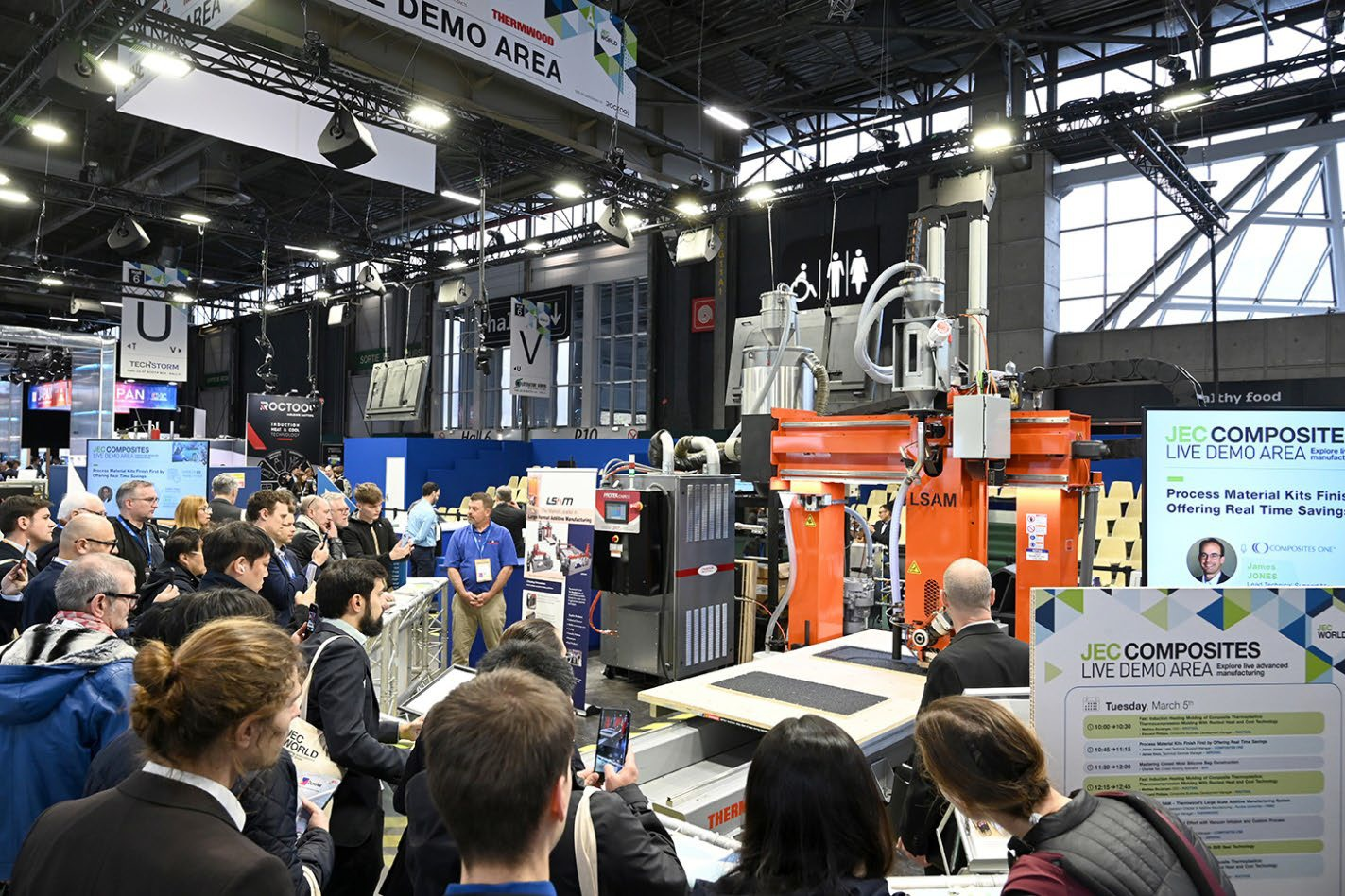
Thermwood will bring its Large-Scale Additive Manufacturing (LSAM) system to the JEC Live Demo Area and will do something genuinely dramatic: live-print a matched pair of carbon fiber-reinforced polycarbonate drone molds each day of the event, March 10–12 [3].
Source: Thermwood
The featured system is the AP510 configuration, which includes:
Each day will feature a different material supplier partner: Airtech, Sabic, and Techmer PM — demonstrating the system's material versatility across high-performance thermoplastic composite feedstocks.
Thermwood is also partnering with Purdue University's Composites Manufacturing & Simulation Center. Eduardo Barocio, director of the Composites Additive Manufacturing and Simulation (CAMS) Consortium, will be on hand to demonstrate Additive3D software — a simulation tool that predicts both the printing process and the as-manufactured performance of large-format printed parts [3].
The Tooling Revolution
The application being demonstrated — drone molds — is strategically chosen. Composite tooling represents one of the highest-value immediate applications for large-scale additive manufacturing. Traditional composite tooling is expensive, time-consuming to manufacture (6–20 weeks), and typically requires expensive Invar or machined aluminum. LSAM-printed composite tooling in high-temperature carbon fiber-filled thermoplastics offers:
| Parameter | Traditional Machined Tooling | LSAM Composite Tooling |
|---|---|---|
| Lead time | 8–20 weeks | 3–10 days |
| Material | Aluminum or Invar | CF/PEEK, CF/PC, CF/PEI |
| Capital cost (large tool) | $150,000–$500,000+ | $30,000–$100,000 |
| Weight | High (Invar: ~8 g/cm³) | Low (CFRP: ~1.5 g/cm³) |
| Thermal expansion | Metal CTE mismatch risk | CTE-matched to part |
| Design iteration speed | Slow (weeks per revision) | Fast (days per revision) |
For manufacturers developing new composite products, the ability to iterate tooling in days rather than months compresses the product development cycle dramatically. LSAM positions large-format additive manufacturing as not just a prototyping technology but a production tooling platform.
Thermwood LSAM AP510 — System Architecture
Live Demo #3 — Caracol Robotic Manufacturing
Source: Caracol
What Caracol Is Demonstrating
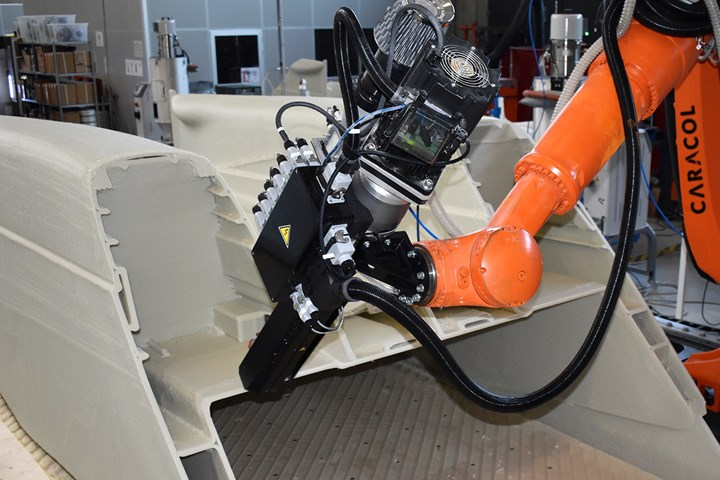
Caracol AM, the Italian robotic additive manufacturing specialist, is presenting at JEC World 2026 with a focus on revolutionizing composites parts production for mobility applications. The company's Heron AM platform — a 6+ axis robotic additive extrusion system — produces large, geometrically complex polymeric and composite parts for aerospace, marine, automotive, and mobility applications [5].
Caracol's approach is distinct from gantry-based LSAM systems. By mounting the extrusion head on a 6-axis industrial robot arm (combined with a rotating positioner for 7th and 8th axes), the Heron AM system achieves:
- Continuous fiber deposition on curved and doubly-curved surfaces
- Non-planar printing paths that follow structural load paths
- Part sizes limited only by robot reach (typically 3–6 meter working envelopes)
- Multi-material capability for structural and support material deposition
The mobility focus at JEC 2026 is significant. Automotive and mobility applications demand both the geometric complexity that 6-axis robotics enables and the production economics that large-format printing can provide for low-to-medium volume parts.
Recent Growth Signal: $40M Funding Round
A strong indicator of market confidence in Caracol's approach: the company recently raised $40 million to "propel large-format robotic manufacturing" [6]. This funding round — significant for a composites technology company — validates the commercial trajectory of robotic composite manufacturing and underscores why JEC 2026's expanded Live Demo Area includes this category prominently.
CMS KREAROB — A Complementary Robotic LFAM System
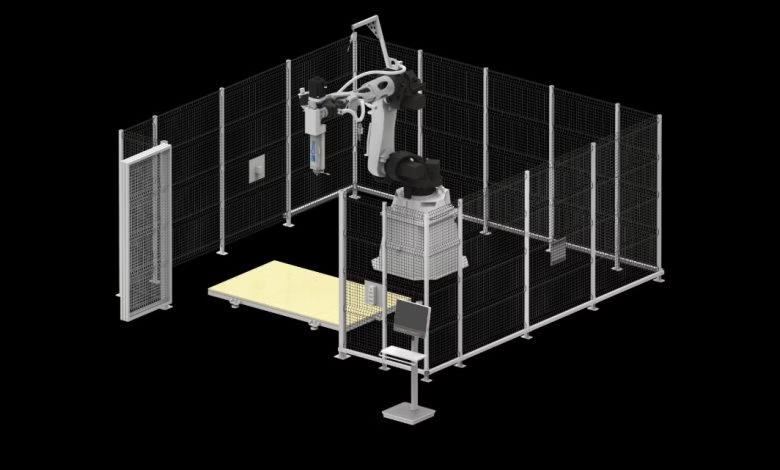
Also exhibiting at JEC 2026 in the robotic LFAM space is CMS Advanced Materials Technology with its KREAROB system [7]. KREAROB is a robotic thermoplastic polymer extrusion system designed specifically for composite tooling and large models:
Source: KREAROB
KREAROB is positioned as an additive production cell for composite tooling — a direct competitor to Thermwood's LSAM in the tooling market, with robotic flexibility enabling non-planar geometries that gantry systems cannot achieve.
Other Confirmed Demonstrations
Mikrosam — Composite Automation Starts with Material Control
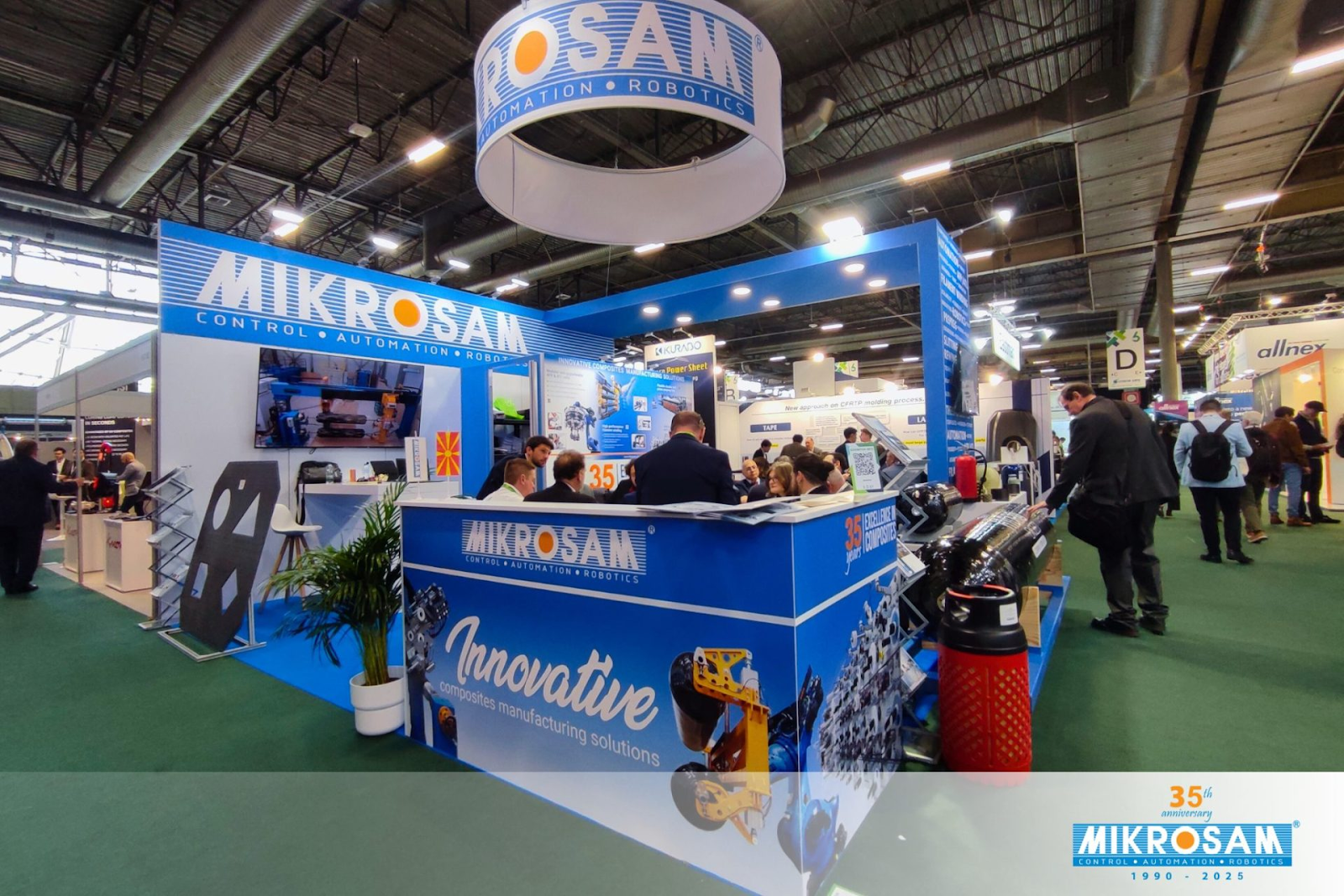
Mikrosam (Hall 6, Booth D61) will demonstrate a suite of automation solutions aimed directly at democratizing composite manufacturing [8]:
Source: Mikrosam
Latest developments in affordable AFP systems for research, prototyping, and low-volume production
Material preparation automation reducing material costs and enabling custom slit widths
Advanced process control with automatic cut-and-restart for pipes and small diameters
Real-time process monitoring and data logging for quality traceability
Mikrosam's position in the market — offering automation systems at price points accessible to smaller manufacturers — aligns with the broader democratization trend. Their presence at the Live Demo Area underscores that AFP and filament winding automation are no longer exclusively the domain of Tier 1 aerospace giants.
Table 1: All Confirmed Live Demonstrations — JEC World 2026
| Company | Technology | Application Focus | Key Capability |
|---|---|---|---|
| Roctool | RTF™ In-Mold Thermal Fusion | Thermoplastic composite assembly | In-tool bonding, no adhesives/fasteners |
| Thermwood | LSAM Large-Scale Additive | Composite tooling (drone molds) | Live printing, 5'×10' parts, 450°F max |
| Caracol AM | Heron AM Robotic LFAM | Mobility/automotive composites | 6+ axis non-planar composite printing |
| CMS | KREAROB Robotic LFAM | Composite tooling and models | 30 kg/h, 3m radius, 5-axis |
| Mikrosam | AFP + Filament Winding | Aerospace, pressure vessels, general | Multi-spindle, SCADA integration |
| Purdue University / Additive3D | AM Process Simulation | LFAM print prediction | Simulate print + as-manufactured performance |
Additional demonstrations may be confirmed; check the JEC Live Demo Area page for updates [1].
The Automation Imperative
The expansion of JEC's Live Demo Area is not arbitrary — it is a direct response to structural forces reshaping composites manufacturing. Three converging drivers are making automation not just attractive but existentially necessary.
Driver 1: The Labor Crisis
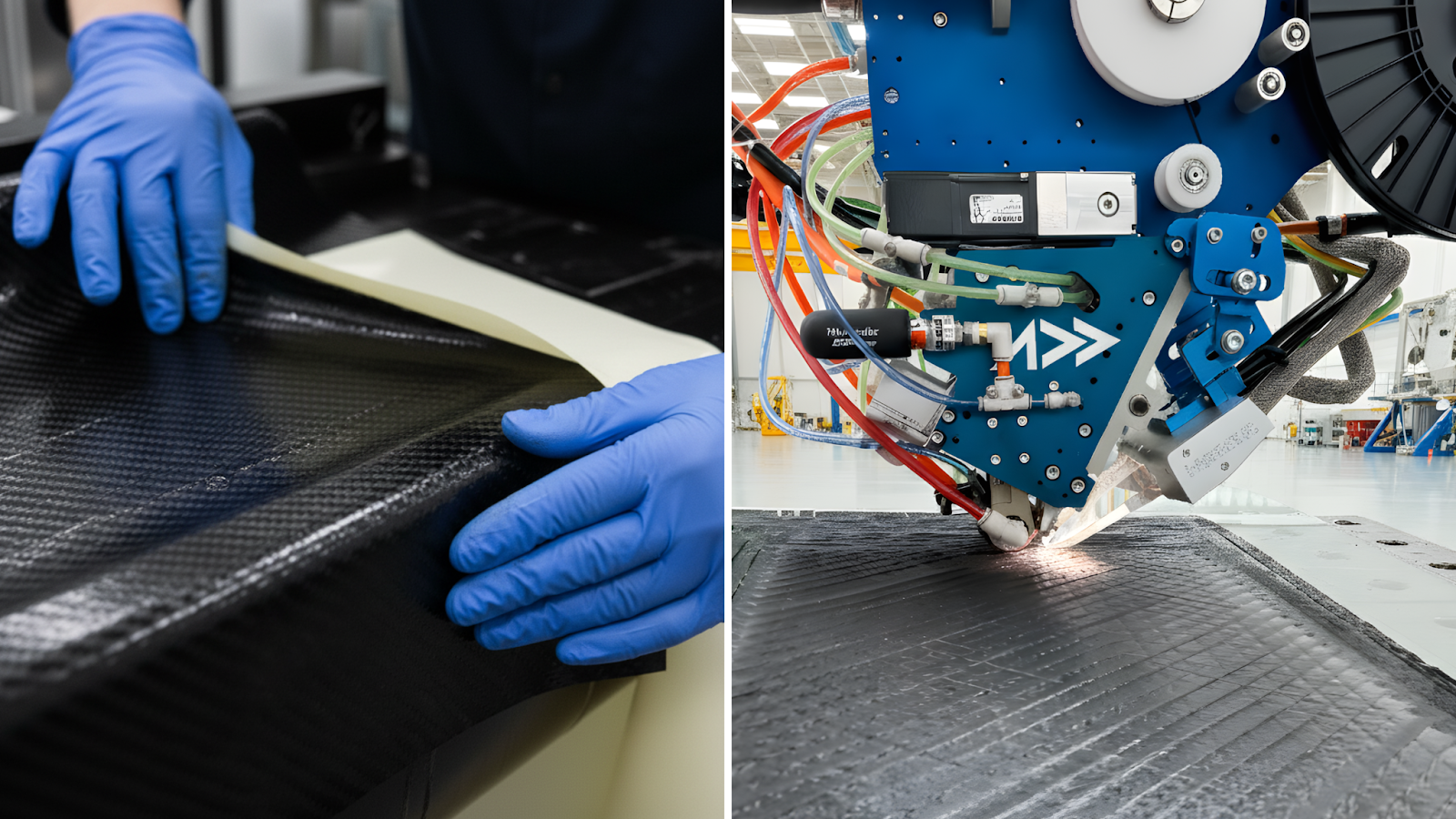
Manual hand layup (left) vs. automated fiber placement (right) — AFP systems deliver superhuman repeatability while addressing the growing skilled labor shortage in composites manufacturing.
The composites manufacturing industry faces a skills crisis of significant proportions. The broader U.S. manufacturing sector alone faces a projected shortfall of nearly 2 million skilled workers over the next decade [9]. For composites specifically, the challenge is compounded by the specialized nature of hand layup and lamination skills — expertise that takes years to develop and is not easily replaced.
A 2025 analysis by Plataine documented the severity: aerospace composites manufacturing is experiencing a severe shortage of skilled laminators, and traditional training pipelines cannot keep pace with demand from expanding aircraft programs. The labor cost per composite part continues to rise, eroding the competitive economics of manual manufacturing for all but the most complex geometries.
Automation addresses this directly. AFP systems operating at throughput rates of 1–50 kg/hour (depending on system scale and material) can replace the output of multiple skilled laminators while operating continuously, without fatigue, and with documented process parameters for every layer.
Driver 2: Quality Consistency Requirements
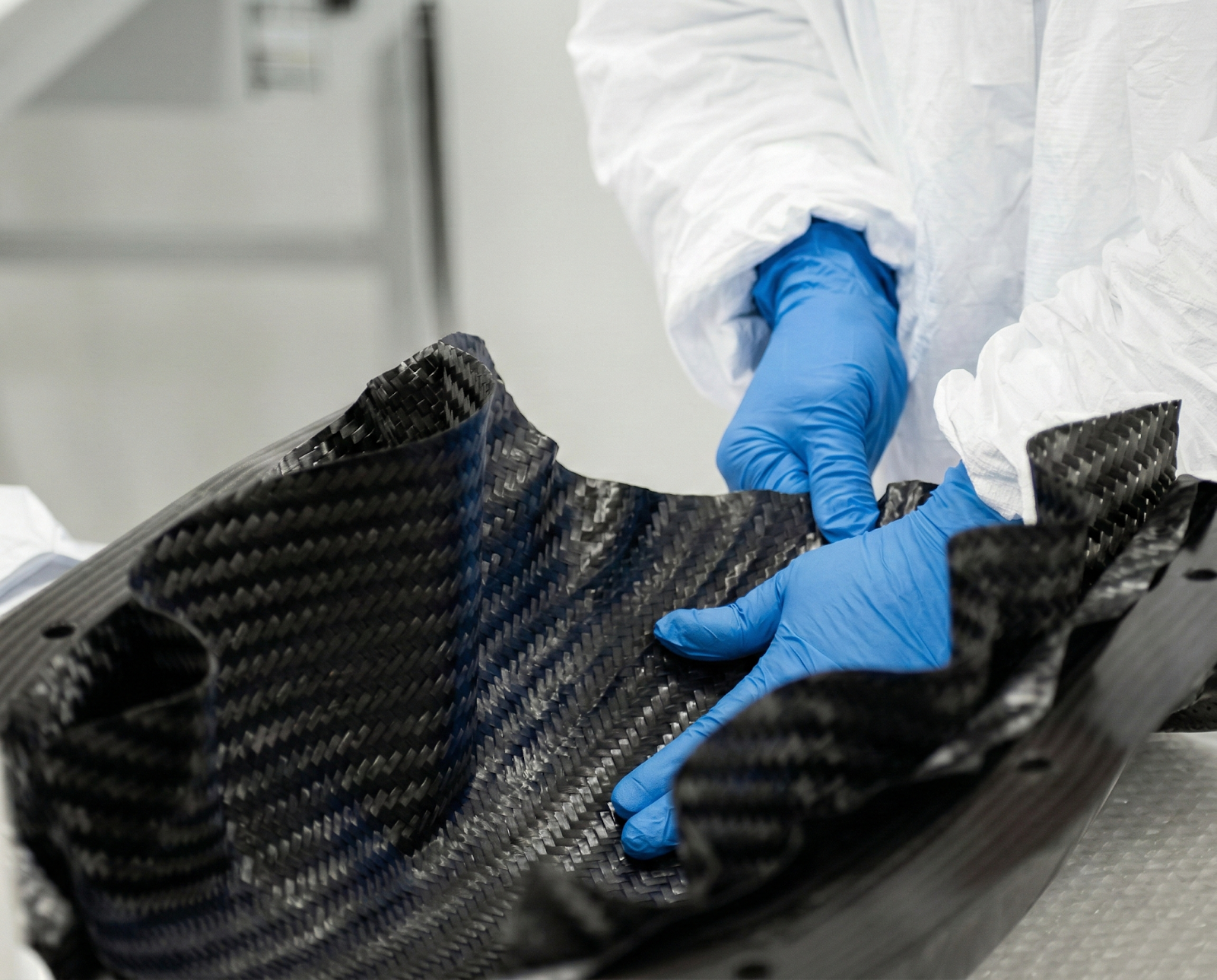
Aerospace certification requirements — and increasingly automotive quality standards — demand repeatability that manual manufacturing simply cannot guarantee at scale. Human variability in ply placement, fiber orientation accuracy, compaction pressure, and heat application creates quality distributions that require extensive inspection and generate scrap rates that automated systems eliminate.
The ROI data is compelling:
- Case studies in automated composite manufacturing report lead time reductions of 50–96% and cost reductions of 20–79% across applications [10]
- An AFP system at €3,500/month matches the all-in cost of 1–2 skilled laminators while delivering superhuman repeatability and generating digital process records for every part
Driver 3: Speed to Market
Product development cycles in aerospace, automotive, and energy are compressing. New aircraft programs, EV platforms, and hydrogen storage systems need composite components qualified and in production faster than previous generations. Automation, combined with digital path planning software and simulation tools (see the Thermwood/Purdue Additive3D demonstration above), compresses iteration cycles and enables "first-time-right" manufacturing — a capability explicitly demonstrated by the IFW Hannover AFP finalist project at JEC 2026 (covered in Blog 9 of this series).
Cost Per Part vs. Annual Production Volume
AFP & Filament Winding — The Automation Workhorses
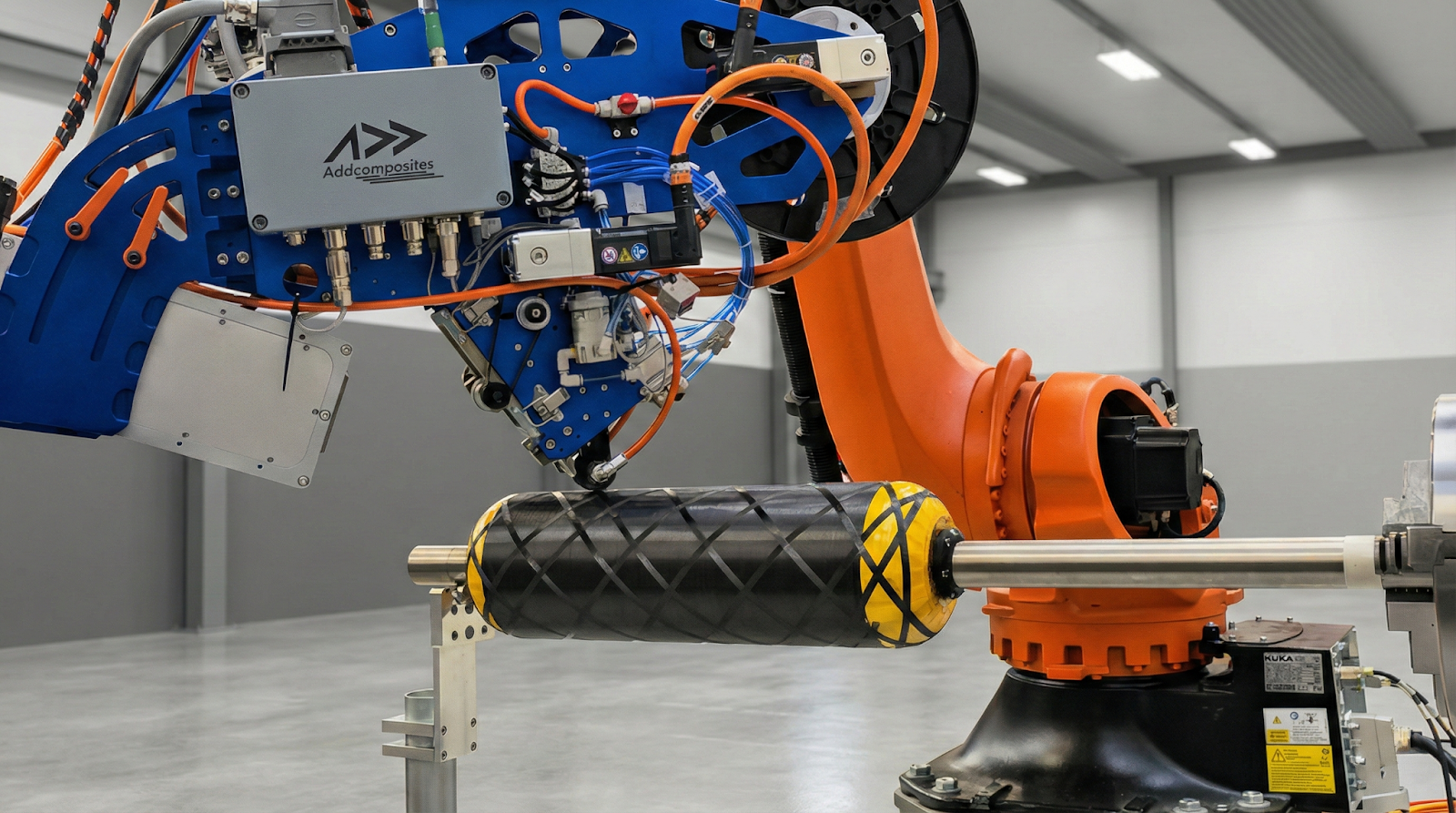
While the JEC Live Demo Area showcases exciting emerging technologies, it is worth grounding the discussion in the two most mature and widely deployed automated composite manufacturing technologies: Automated Fiber Placement (AFP) and filament winding. These are not emerging technologies — they are proven workhorses that have been manufacturing aerospace structures for four decades, and they are now democratizing rapidly.
The Addcomposites AFP-XS mounted on a KUKA robot arm, performing filament winding on a composite pressure vessel — one toolhead, multiple manufacturing processes, any robot.
The AFP Evolution: From Aerospace-Only to Universal
AFP emerged in the 1980s as a solution to the productivity limitations of hand layup for large aerospace structures. Early systems — built by companies like Cincinnati Milacron and Ingersoll — were multi-story gantry machines costing $1–5 million and requiring dedicated facilities. They were, by definition, accessible only to Tier 1 aerospace manufacturers: Boeing, Airbus, Lockheed Martin, and their direct partners.
This architecture remained essentially unchanged for three decades. Then, around 2015–2020, a new design philosophy emerged: instead of building the entire machine around the AFP function, build an AFP end-effector that mounts on any industrial robot arm. This seemingly simple insight — turning AFP from a machine into a toolhead — is the most disruptive architectural change in the technology's history.
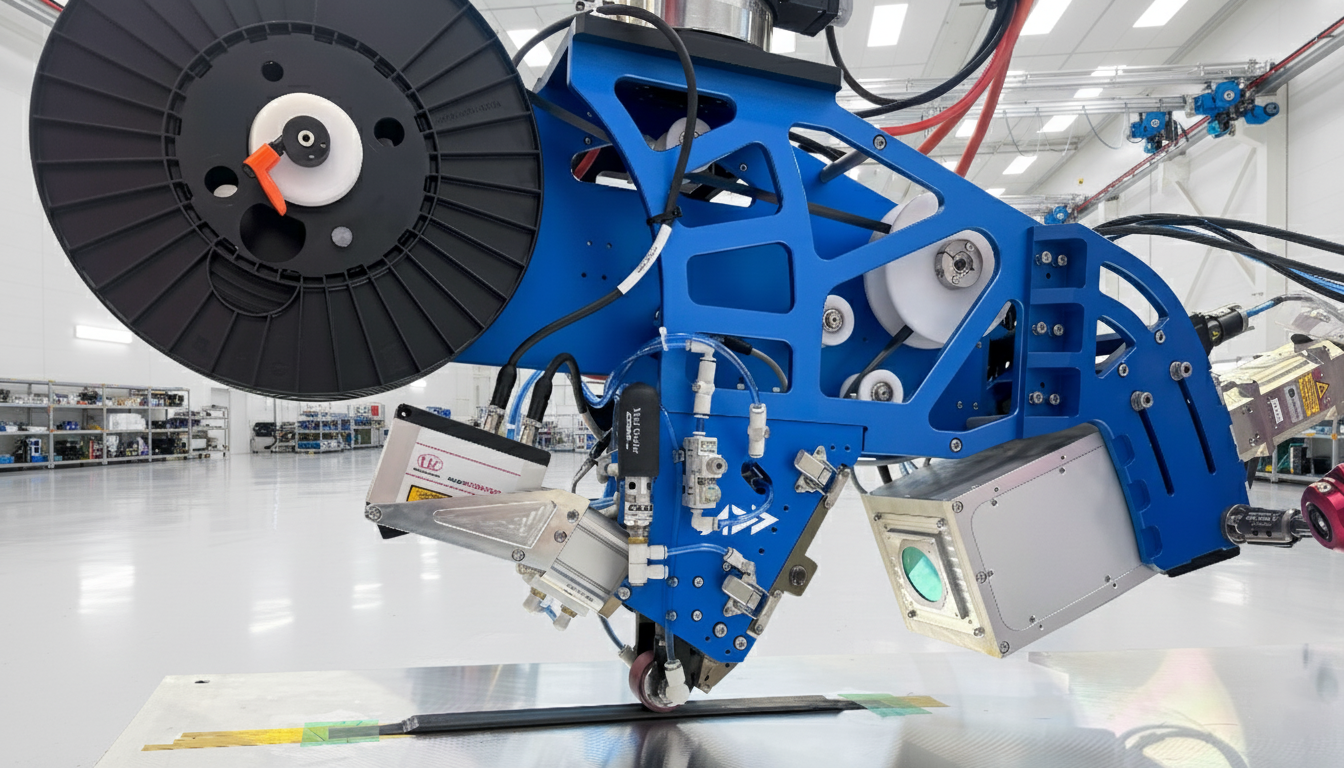
Close-up of the Addcomposites AFP-XS toolhead with integrated tape feed, compaction, and process monitoring sensors
AFP Technology Evolution — From Aerospace Giants to Accessible Manufacturing
The robot-mounted AFP approach unlocks several fundamental shifts:
Robot + AFP toolhead = $150,000–$500,000 all-in vs. $1–5M for traditional systems
Affordable monthly access eliminates capital expenditure barrier
Same robot can perform multiple operations (AFP, machining, inspection, material handling)
Any manufacturer with an industrial robot arm can add AFP capability
Addcomposites has been at the forefront of this democratization, developing the AFP-XS and AFP-X toolheads compatible with any major robot brand (KUKA, ABB, Fanuc, Universal Robots). With leasing options starting from approximately €3,500/month, AFP has crossed the accessibility threshold for small and medium enterprises — a fact highlighted at JEC 2026 as Mikrosam also brings affordable AFP systems to the Live Demo Area [8].
Table 2: AFP System Accessibility — The Market Evolution
| System Type | Example | Capital Cost | Who Can Access | Typical Applications |
|---|---|---|---|---|
| Traditional gantry AFP | Electroimpact, MTorres | $1–5M+ | Tier 1 Aerospace only | 787 fuselage, A350 wing skins |
| Large robotic AFP cell | Coriolis Composites | $500K–$1.5M | Large Tier 1/2 suppliers | Structural aerospace components |
| SME robotic AFP cell | Mikrosam AFP-R series | $150K–$400K | Tier 2/3, research | Prototyping, structural parts |
| Robot-mounted AFP toolhead | Addcomposites AFP-XS | €3,500/month lease | SMEs, universities, startups | R&D, low-volume, thermoplastics |
| Build-your-own AFP | Addcomposites + robot | €3,500/month + robot | Any manufacturer with a robot | Maximum flexibility |
Filament Winding — The Pressure Vessel Backbone
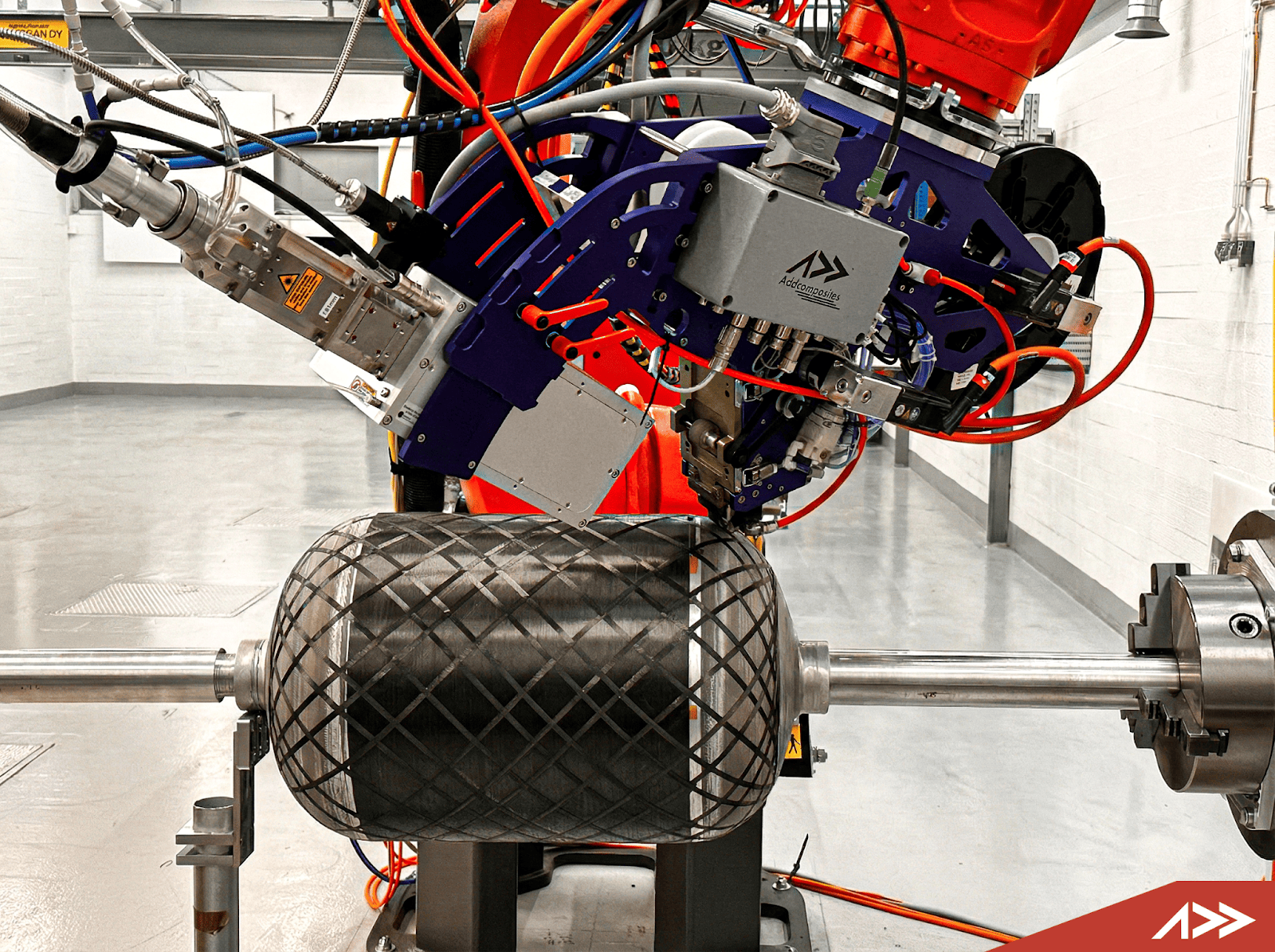
Filament winding, the complementary automation technology, has an even longer history and remains the dominant process for composite pressure vessels — a market growing rapidly with hydrogen economy development (covered in Blog 6 of this series). The JEC automation story in 2026 is incomplete without acknowledging that filament winding systems are among the highest-volume automated composite manufacturing platforms globally, with Mikrosam's multi-spindle automated winding systems representing the state of the art in high-volume production with SCADA integration.
Addcomposites AFP-XS winding a composite pressure vessel.
Table 3: Automation Technology Comparison — Key Parameters
| Technology | Deposition Rate | Part Complexity | Material Types | Cost Threshold | Best Application |
|---|---|---|---|---|---|
| Automated Fiber Placement (AFP) | 1–50 kg/hr | High (doubly curved) | Thermoset prepreg, thermoplastic tape, dry fiber | €3,500/month (toolhead) | Aerospace structures, pressure vessel domes, complex shells |
| Automated Tape Laying (ATL) | 50–200 kg/hr | Low-medium (near flat) | Thermoset prepreg, thermoplastic tape | $500K–$2M | Wing skins, large flat/slightly contoured panels |
| Filament Winding | 2–20 kg/hr | Rotationally symmetric | Towpreg, wet filament, thermoplastic tape | $50K–$500K | Pressure vessels, pipes, drive shafts, tanks |
| LSAM / Robotic LFAM | 5–100 kg/hr | Very high (freeform) | CF-filled thermoplastic pellets | $200K–$1.5M | Tooling, large enclosures, complex structures |
| Robotic Pick & Place | N/A (preforms) | High (stack sequences) | Woven fabric, NCF, prepreg | $100K–$300K | Preform layup for RTM, preform automation |
Robotic Manufacturing Trends at JEC 2026
Across the Live Demo Area and the broader JEC show floor, several recurring themes define where robotic composite manufacturing is heading in 2026 and beyond.
1. Universal Robot Compatibility
The shift from bespoke AFP/winding machines to robot-compatible toolheads is creating pressure for universal compatibility. Manufacturers want systems that work with the robots they already have — KUKA, ABB, Fanuc, Universal Robots — without vendor lock-in. The AFP toolhead model pioneered by Addcomposites is now being adopted more broadly, and the JEC 2026 demonstrations from Mikrosam, Caracol, and others all leverage standard industrial robot platforms rather than bespoke motion systems.
2. Vision-Guided Inspection Integration
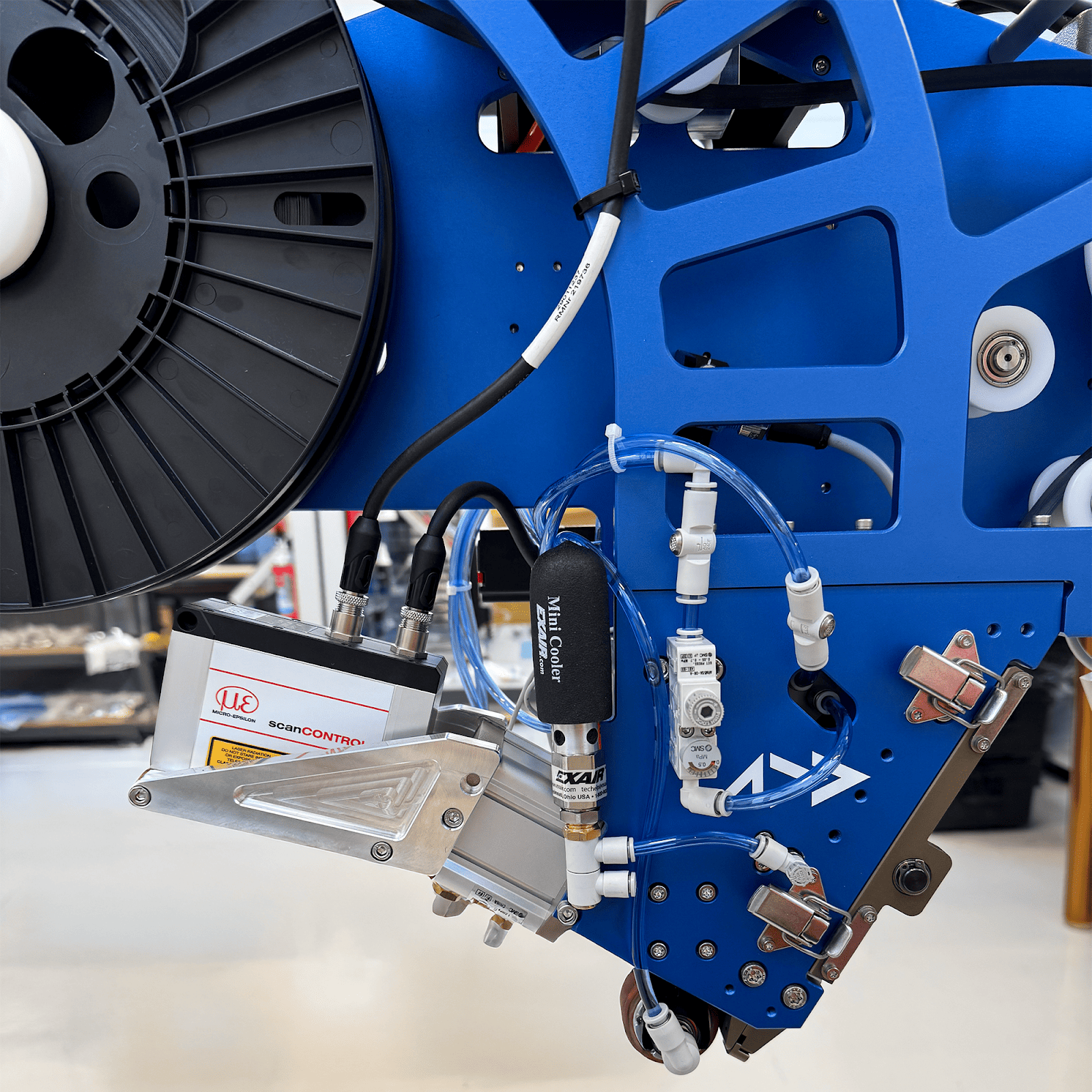
Automated manufacturing without automated inspection is incomplete. JEC 2026 conference presentations and exhibitor demonstrations increasingly feature in-process quality monitoring — cameras, laser line scanners, and thermographic systems mounted alongside deposition heads to catch defects as they occur rather than after layup is complete. The AFP sensor fusion research covered in Blog 1 of this series (the Addcomposites AFP sensor fusion work) directly enables this approach.
3. Multi-Robot Integration
Single-robot AFP cells are giving way to multi-robot workcells — one robot places material while another positions the mandrel or performs inspection. For large structures (fuselage sections, wind turbine spars), simultaneous multi-head AFP from multiple robots dramatically increases throughput. JEC 2026 conference sessions address multi-robot path planning as a key challenge for next-generation high-rate manufacturing.
4. Path Planning Software — The Intelligence Layer
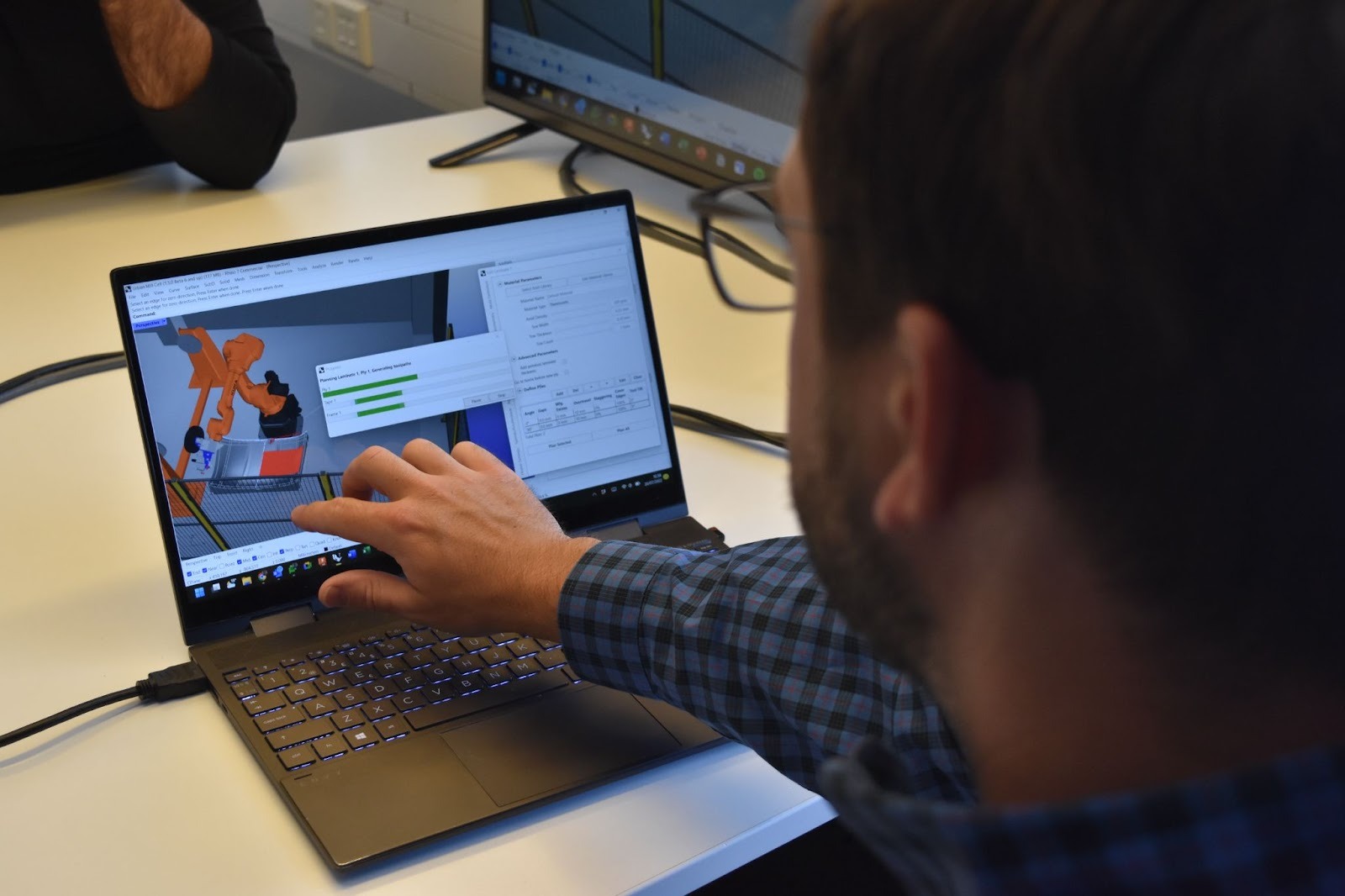
Hardware without software is a machine; hardware with path planning intelligence is a manufacturing system. The growing importance of digital path planning is visible throughout JEC 2026 — from Thermwood's partnership with Purdue's Additive3D simulation platform to Addcomposites' AddPath software that connects composite design to robot-executable AFP programs. Path planning software translates structural requirements (fiber orientations, coverage patterns, steering constraints) into robot-executable trajectories while predicting defect formation and optimizing process parameters.
Digital Thread Workflow — Design to Quality Assurance Loop
The SAUBER4.0 Connection
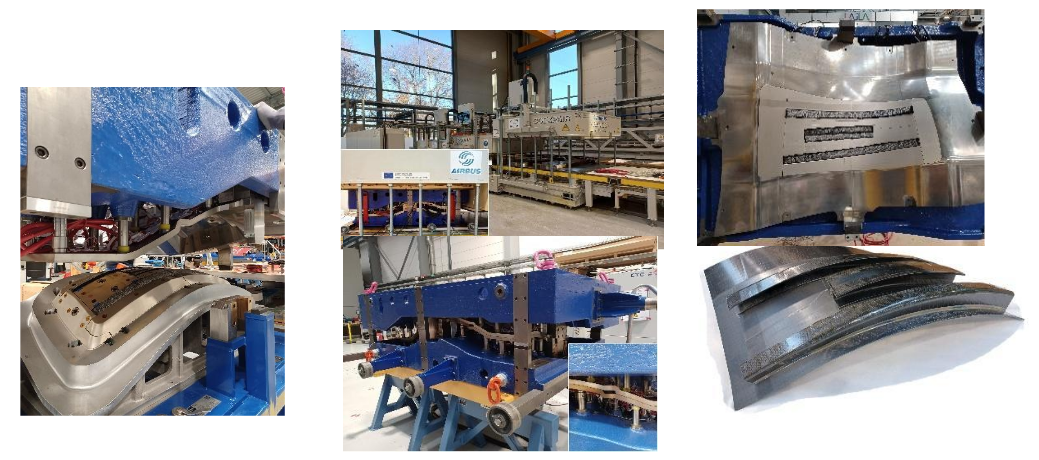
No discussion of automation at JEC 2026 would be complete without addressing the SAUBER4.0 project — the winner of the JEC Composites Innovation Award in the Aerospace – Process category. SAUBER4.0 is not a Live Demo Area demonstration, but it represents the most complete vision of what an automated, digitized composite factory can look like.
Source: JEC
What SAUBER4.0 Is
SAUBER4.0 (led by CTC GmbH – An Airbus Company, with 13 partners including DLR, Fraunhofer IFAM, Fraunhofer IWU, KraussMaffei, Siemens, Teijin Carbon Europe, and Testia GmbH) is described as a "holistically networked manufacturing technology for complex large components" that places equal emphasis on ecological and economic criteria [13].
The technical core is RTM (Resin Transfer Moulding) for large aerospace components, but what makes SAUBER4.0 award-winning is the integration:
Complete digital thread from preform design through cure to part release
Automated fiber preform production with precise fiber orientation control
Intelligent mold systems with embedded sensors and adaptive process control
All process steps linked, with real-time data exchange between preforming, infusion, cure, and inspection stations
Ecological integration:
Carbon footprint accounting embedded in the process chain, not added as an afterthought
Why SAUBER4.0 Represents the Future Factory
SAUBER4.0 is significant because it demonstrates that the individual components visible in the Live Demo Area — automated preforming, smart tooling, digital process monitoring, automated inspection — are not separate technologies but elements of an integrated manufacturing system. The innovation is not any single technology but the integration architecture that makes them work together.
SAUBER 4.0 — Digital Backbone Architecture
For composites manufacturers looking to understand where industrial automation is heading, SAUBER4.0 is the clearest signal available: the future is not a single automated machine, but a network of automated systems that share data, adapt in real time, and optimize across the entire manufacturing chain.
Conference Sessions on Automation
Beyond the Live Demo Area, JEC World 2026's three-stage conference program includes several sessions directly relevant to manufacturing automation:
From the JEC Program [15]:
How modeling, AI, and digital twins are transforming composite design and manufacturing. Sessions address automated path planning, process simulation, and defect prediction — the software layer that makes automated manufacturing systems intelligent.
Covering multi-robot integration, universal robot compatibility, in-situ quality monitoring, and high-rate manufacturing for aerospace programs. Key speakers include representatives from Airbus, Boeing, and Tier 1 suppliers actively deploying automation.
The Society for the Advancement of Material and Process Engineering co-presents technical sessions at JEC 2026 covering advanced process development, including AFP process optimization, thermoplastic tape winding, and automated preforming.
Caracol — "Revolutionizing Composites Parts Production for Mobility with Robotic Advanced Manufacturing"; Roctool — "Roctool Thermal Fusion (RTF™) — Introducing Production-Ready In-Mold Thermoplastic Fusion with Roctool Technology"
What This Means for the Industry
The Convergence Point
JEC World 2026's Live Demo Area captures a historic moment: the convergence of multiple automated manufacturing technologies that, individually, have been developing for decades but are now mature enough to compete for the same production floor space. Thermoplastic fusion, large-format additive manufacturing, robotic composite deposition, and automated fiber placement are no longer experimental — they are live, running, producing real parts in Hall 6, Paris.
This convergence has a natural endpoint: the integrated automated composite factory. Not a factory with one automated process, but a factory where preforming, layup, consolidation, bonding, inspection, and data capture are all automated and networked. SAUBER4.0 is the most complete realization of this vision currently demonstrated at scale.
The Accessibility Revolution
The second critical story at JEC 2026 automation is not about the most advanced systems — it is about the most accessible ones. The presence of Mikrosam in the Live Demo Area, alongside Addcomposites' approach of robot-mounted AFP toolheads at €3,500/month, signals that the automation revolution is no longer reserved for companies with $5M capital budgets.
The AFP market is bifurcating:
At the high end:
Integrated, highly automated cells for Tier 1 aerospace at high rates
At the accessible end:
Robot-mounted toolheads, rental models, SME-friendly systems for research, prototyping, and low-to-medium production
Both segments are growing. The accessible end is growing faster, because it is unlocking demand from organizations that simply could not access AFP before. Universities, Tier 2/3 suppliers, automotive Tier 1s exploring composites, energy sector manufacturers pivoting to composite pressure vessels — these markets are large and largely untapped by traditional AFP vendors.
Table 4: Composites Automation Market Data
| Metric | Value | Source |
|---|---|---|
| Global fiber reinforced composites market (2025) | $101.16 billion | Mordor Intelligence [16] |
| Projected market size (2030) | $142.81 billion | Mordor Intelligence [16] |
| CAGR 2025–2030 | 7.14% | Mordor Intelligence [16] |
| AFP-specific CAGR to 2030 | 8.12% | Market Research Future [16] |
| Automation adoption: US manufacturers planning new automation by 2028 | 95% | Supply Chain 24/7 [9] |
| AFP cost reduction at >150 parts/year vs. hand layup | 43% | Addcomposites analysis [10] |
| Defect reduction: AFP vs. hand layup | 94% | Addcomposites analysis [10] |
| Lead time reduction range: automated vs. manual | 50–96% | CompositesWorld [17] |
The Addcomposites Position
Addcomposites' presence at JEC 2026 sits at the intersection of all the trends visible in the Live Demo Area: thermoplastic AFP (the manufacturing method behind Daher's award-winning wing rib), robotic automation (the platform model behind accessible AFP), path planning software (the intelligence layer behind AddPath), and SME accessibility (the market model behind affordable monthly leasing).
The technologies being demonstrated in Hall 6 are not the future — they are the present, made visible. For any manufacturer who attends JEC 2026 and walks past the Thermwood LSAM printing drone molds, Roctool fusing thermoplastic composites, Caracol robots depositing composite feedstock, and Mikrosam winding pressure vessel shells, the message is the same: automated manufacturing of composites is here, it is accessible, and the question is no longer whether to automate but which path to take.
References
[1] JEC World 2026, "Live Demonstration Area," JEC World Program, 2026. [Online]. Available: https://www.jec-world.events/program/live-demo-area
[2] Roctool, "Roctool Thermal Fusion (RTF™) — JEC World 2026," Roctool Press Release, 2026. [Online]. Available: https://www.roctool.com/press-release/roctool-thermal-fusion-jec-world-2026/
[3] Surface & Panel, "Thermwood to Live-Print Carbon-Fiber Drone Molds at JEC World 2026," Surface & Panel, 2026. [Online]. Available: https://www.surfaceandpanel.com/thermwood-to-live-print-molds-jec-world-2026/
[4] CompositesWorld, "Live demos unlock Thermwood LSAM system potential," CompositesWorld, 2026. [Online]. Available: https://www.compositesworld.com/news/live-demos-unlock-thermwood-lsam-system-potential
[5] Caracol AM, "Advanced Manufacturing Solutions," Caracol AM, 2026. [Online]. Available: https://www.caracol-am.com/
[6] JEC Composites, "Caracol raises $40 million to propel large-format robotic manufacturing," JEC Composites, 2025. [Online]. Available: https://www.jeccomposites.com/news/by-jec/caracol-raises-40-million-to-propel-large-format-robotic-manufacturing/
[7] VoxelMatters, "CMS to show KREAROB robotic LFAM system at JEC World 2026," VoxelMatters, 2026. [Online]. Available: https://www.voxelmatters.com/cms-to-show-krearob-robotic-lfam-system-at-jec-world-2026/amp/
[8] Mikrosam, "Mikrosam at JEC World 2026: Composite automation starts with material control," Mikrosam, 2026. [Online]. Available: https://mikrosam.com/jec-world-2026/
[9] Supply Chain 24/7, "Report: 95% of U.S. Manufacturers Plan New Automation by 2028," Supply Chain 24/7, 2025. [Online]. Available: https://www.supplychain247.com/article/us-factories-automation-reshoring-labor-shortages-2025
[10] Addcomposites, "AFP vs Hand Layup: The Manufacturing Revolution Reshaping Composite Production," Addcomposites Blog, 2025. [Online]. Available: https://www.addcomposites.com/post/afp-vs-hand-layup-the-manufacturing-revolution-reshaping-composite-production-ojc6p
[11] CompositesWorld, "Increasing access to AFP," CompositesWorld, 2023. [Online]. Available: https://www.compositesworld.com/articles/increasing-access-to-afp
[12] Addcomposites, "Addcomposites' AFP-XS System: Democratizing Automated Fiber Placement for Small and Medium Enterprises," Addcomposites Blog, 2024. [Online]. Available: https://www.addcomposites.com/post/addcomposites-afp-xs-system-democratizing-automated-fiber-placement-for-small-and-medium-enterprises
[13] CompositesWorld, "Top 11 winners of JEC Composites Innovation Awards 2026," CompositesWorld, 2026. [Online]. Available: https://www.compositesworld.com/news/top-11-winners-of-jec-composites-innovation-awards-2026
[14] Innovation in Textiles, "JEC World 2026 Innovation Awards winners revealed," Innovation in Textiles, 2026. [Online]. Available: https://www.innovationintextiles.com/jec-world-2026-innovation-awards-winners-revealed/
[15] JEC World 2026, "Conferences," JEC World Program, 2026. [Online]. Available: https://www.jec-world.events/program/conferences
[16] Mordor Intelligence, "Fiber Reinforced Composites Market Size, Trends & Industry Growth Report, 2030," Mordor Intelligence, 2025. [Online]. Available: https://www.mordorintelligence.com/industry-reports/fiber-reinforced-composites-market
[17] CompositesWorld, "Automation options arise for labor-intensive composites," CompositesWorld, 2024. [Online]. Available: https://www.compositesworld.com/articles/automation-options-arise-for-labor-intensive-composites
Learn More
Interested in bringing automated composite manufacturing to your facility?
Contact Us for a Consultation